



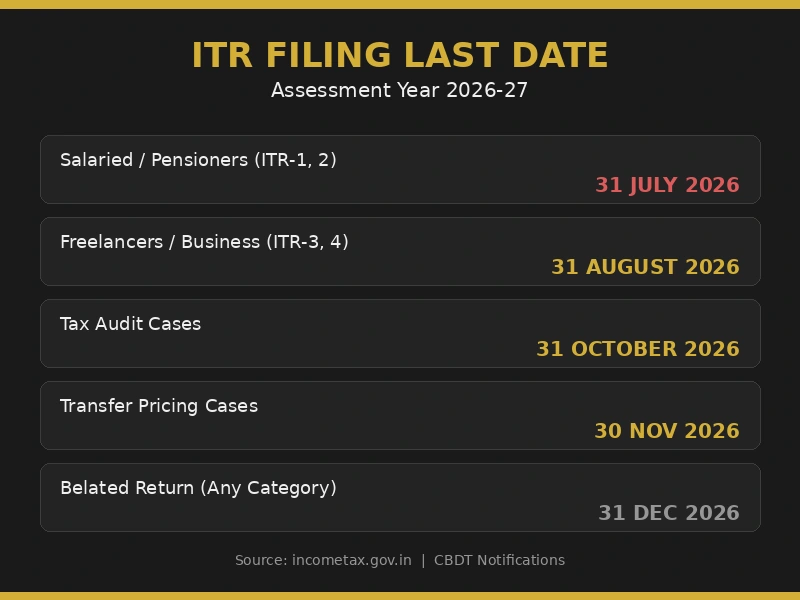
31 July 2026 — Salaried employees, pensioners, non-audit ITR-1/ITR-2 filers (deadline passed)
31 August 2026 — Freelancers, professionals, small business owners, non-audit ITR-3/ITR-4
31 October 2026 — Businesses requiring tax audit
30 November 2026 — Transfer pricing report cases
31 December 2026 — Last date for belated return, if you already missed your deadline
No CBDT extension has been announced as of publish date. Check incometax.gov.in for real-time updates before you file.
Every year, as July approaches, one question keeps coming up: what is the income tax return filing last date this year? And this year, the question matters even more, because a lot of websites are giving out wrong or outdated dates. Some articles are still saying 15 September, when that was actually last year’s deadline.
This guide gives you the full picture, not just a date: which category you fall into, what happens if you miss the deadline, and what your next steps should be. A lot of taxpayers get confused about the last date for filing income tax return in india because every category has a different deadline. Whether you’re a salaried employee, a freelancer, or filing your ITR for the first time, this guide is for you.
Income Tax Return Filing Last Date for AY 2026-27 (Category-Wise)
The first mistake most people make is assuming everyone has the same deadline. That’s not true. Your income tax return filing last date 2025 26 depends on which ITR form you’re filing and whether your accounts are subject to audit.
| Taxpayer Category | Applicable ITR Form | Due Date |
| Salaried employees, pensioners (non-audit) | ITR-1, ITR-2 | 31 July 2026 (passed) |
| Freelancers, professionals, small business owners (non-audit) | ITR-3, ITR-4 | 31 August 2026 |
| Businesses requiring tax audit | ITR-3 | 31 October 2026 |
| Cases requiring transfer pricing report | ITR-3, ITR-6 | 30 November 2026 |
| Belated return (any category) | Applicable form | 31 December 2026 |
Let’s clear up something that’s causing a lot of confusion online. A lot of people search for the income tax return filing last date 2025 and land on outdated pages, because last year, for AY 2025-26, CBDT officially extended the deadline to 15 September 2025 due to major structural changes in the ITR forms and the time utilities took to get ready. A number of outdated or poorly maintained websites simply copied that same date over for this year, which is incorrect. This year the forms arrived on time, so no extension was needed and the original 31 July deadline stood.
Real example: Suppose Priya is a marketing executive in Gurgaon with salary income and one house property. Her applicable form is ITR-1, and her deadline was 31 July 2026. If she hasn’t filed yet, she is now technically a late filer and will need to go through the belated return route.
Has the Income Tax Return Filing Last Date Been Extended in 2026?
Short answer: no, not so far. The original 31 July 2026 deadline has passed, and no official extension has been announced by CBDT.
It’s important to understand that extensions don’t happen automatically. Last year’s extension happened because the new ITR forms had structural changes, and the income tax department needed extra time to develop, integrate, and test the corresponding utilities. On top of that, credits from TDS statements were also reflecting late, which left an unusually short actual filing window.
This year, there was no such technical reason. The portal was running smoothly and the forms were released on time, so there was no real demand for an extension. That doesn’t mean an extension will never happen, it just means you shouldn’t delay your filing while waiting for one.
Practical tip: Always check official sources, incometax.gov.in or CBDT press releases. Don’t trust extension news floating around on social media or forwarded messages unless there’s an official notification behind it.
What Happens If You Miss the ITR Filing Deadline?
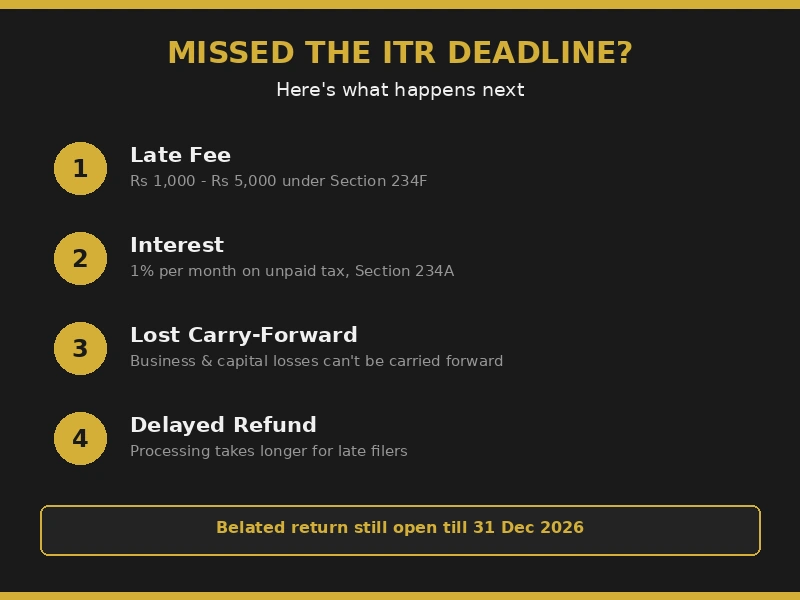
If you’ve already missed your original deadline, there’s no need to panic, but you do need to act. Here’s what happens once the deadline passes:
You get the belated return option. You can file a belated return under Section 139(4), with a last date of 31 December 2026. It works just like an original return, just with a late fee attached.
A late fee applies. Under Section 234F, if your total income is below ₹5 lakh, the fee is ₹1,000, and if it’s higher, the fee can go up to ₹5,000.
Interest gets charged too. If you have any tax due, interest at 1% per month applies on the unpaid amount under Section 234A, until you file.
You lose the ability to carry forward losses. This is the point people overlook the most. If you have business or capital losses you wanted to set off against future income, missing the deadline takes that facility away. Only house property loss can still be carried forward, nothing else.
Refunds get delayed. If you’re owed a refund, late filing pushes back the processing timeline too.
Real example: Raj is a freelance graphic designer who booked a ₹40,000 short-term capital loss from stock trading in 2025-26. If he files his ITR-3 by the 31 August 2026 deadline, that loss can be adjusted against future capital gains for the next 8 years. But if he files late, he loses the right to carry that loss forward, even if he still files a belated return.
Salaried Employees: What You Need to Know
If you’re salaried, understanding the individual income tax return filing last date becomes even more important, because in most cases your form will be ITR-1 (Sahaj), as long as your income and sources are straightforward.
Which form you need: ITR-1 is for people with salary income, one or two house properties (from this year, ITR-1 allows two house properties, earlier only one was allowed), and income below ₹50 lakh. If you have capital gains, foreign assets, or are a company director, you’ll need to file ITR-2 instead.
Verify before filing: Get your Form 16 from your employer, and cross-check it against your AIS (Annual Information Statement) and Form 26AS. TDS mismatches happen often and can trigger a notice later on.
Keep the new tax regime in mind: Under Section 115BAC, the new tax regime is the default. If you want to choose the old regime for deductions (like 80C, HRA), you need to explicitly opt for it at the time of filing.
Real example: Amit is a software engineer based in Noida with two house properties, one self-occupied and one rented out. Earlier, he had to file ITR-2 because of the two properties, but from AY 2026-27, this is now covered under ITR-1 itself, which has made his filing process simpler.
Self-Employed, Freelancers and Small Business Owners: Deadlines That Apply to You
If you’re a freelancer, consultant, or small business owner, your deadline is different from salaried individuals, and you should make the most of it.
Form selection: Those using the presumptive taxation scheme (Section 44AD for business, 44ADA for professionals) file ITR-4. If you maintain regular books or aren’t eligible for the presumptive scheme, ITR-3 applies to you.
Deadline: For non-audit cases, it’s 31 August 2026. If your turnover crosses the threshold and audit becomes mandatory, the deadline extends to 31 October 2026.
Don’t forget advance tax: If your tax liability exceeds ₹10,000, you’re required to pay quarterly advance tax, year-end filing alone isn’t enough. Missing this also attracts interest.
For GST-registered business owners: If you’re GST registered, make sure your GST returns and income tax filings stay consistent, since the department cross-verifies both. If you run into a gst site not working issue during filing, wait a bit and retry rather than repeatedly refreshing, or reach out through the gst customer care number to log a complaint. When generating an e-way bill, also double-check your pin to pin distance calculation, since an incorrect distance entry can create compliance issues that end up complicating your overall tax filing later.
First-Time ITR Filers: Step-by-Step Guide
Filing your ITR for the first time can feel overwhelming, but the process is actually straightforward if you follow the right order.
Step 1: Check your PAN-Aadhaar link. Without linking, your PAN can become inoperative, which blocks filing altogether.
Step 2: Choose the right ITR form. Decide based on your income sources, ITR-1 for salary, ITR-2 for capital gains, ITR-3 or ITR-4 for business or professional income.
Step 3: Log in at incometax.gov.in using your PAN and password, and select the relevant assessment year.
Step 4: Verify the pre-filled data. The portal pre-fills your salary, TDS, and interest income from AIS and Form 26AS. This can sometimes be inaccurate, so check every entry carefully.
Step 5: Claim applicable deductions, such as 80C investments, health insurance premiums, or home loan interest.
Step 6: Submit and e-verify. Your filing is only considered complete once you verify it through Aadhaar OTP, net banking, or EVC, within 30 days.
Common mistake first-timers make: Selecting the wrong ITR form, or forgetting to report an income source, like savings account interest or freelance side income. This small mistake can trigger an income tax demand notice 143(1) down the line, so double-check every entry before filing.
Investors and Pensioners: Special Considerations
For investors: If you have capital gains from stocks, mutual funds, or property, you won’t be eligible for ITR-1, you’ll need to file ITR-2. Short-term and long-term gains are reported separately, and their tax rates differ too.
For pensioners: Pension income falls under “Salaries” if it comes from your employer, but pension from annuity plans falls under “Income from Other Sources.” Getting this classification wrong can also throw off your tax calculation.
Dividend and interest income: This is pre-filled in AIS, but manual cross-checking is essential since broker or bank reporting delays or mismatches happen fairly often.
Income Tax Act 2025: Does It Affect This Year’s Filing?
This is a point that very few articles explain clearly, and it causes a fair amount of confusion.
The new Income Tax Act, 2025, has been in force since 1 April 2026. But filing for AY 2026-27, which covers income from FY 2025-26, is entirely governed by the old 1961 Act. This means it has no procedural impact on this year’s filing.
Put simply: the income you earned in 2025-26 is still governed by the same old rules. The new Act will only apply to income earned from 2026-27 onwards, which will be filed in 2027. Effectively, this filing season is the last one under the familiar 1961 framework.
This gives you some clarity: the filing process, forms, and deductions all remain the same as what you’ve followed in previous years. There’s no need to worry about anything new this time around.
How to File Belated or Revised ITR (If You Missed the Last Date)
If you’ve already missed your deadline, follow these steps.
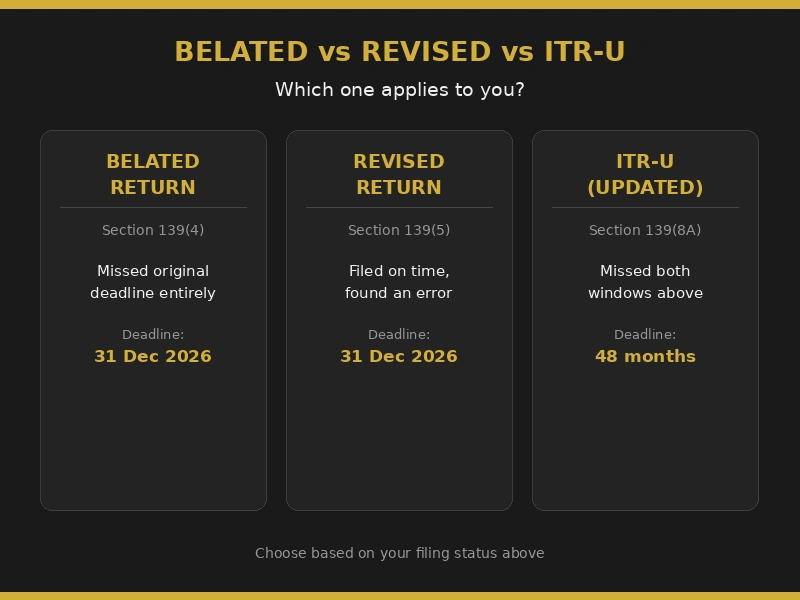
Belated return process: Log in at incometax.gov.in, go to the “File Income Tax Return” section, and select belated return under Section 139(4). The applicable late fee gets calculated automatically during filing. The last date is 31 December 2026.
Revised return if you find an error: If you’ve already filed but later found a mistake, you can file a revised return under Section 139(5), also by 31 December 2026.
ITR-U (Updated Return) if both windows have closed: If both the belated and revised return windows have passed, ITR-U is available, up to 48 months (4 years) from the end of the relevant assessment year. This involves paying additional tax, and it’s used specifically when you need to disclose income that wasn’t reported earlier.
Real example: Neha filed her ITR but forgot to report income from a freelance project. She noticed the mistake in January 2027, by which point the regular revised return window had already closed. In a situation like this, she can file ITR-U to update her income, along with the additional tax.
Frequently Asked Questions
When is the ITR filing last date for AY 2026-27?
For salaried and non-audit individual taxpayers (ITR-1, ITR-2), it was 31 July 2026, which has passed. For non-audit business/professional filers (ITR-3, ITR-4), it’s 31 August 2026. For audit cases, it’s 31 October 2026.
What should I do if I miss the last date?
You can file a belated return under Section 139(4), by 31 December 2026, along with the applicable late fee.
What is the last date for filing a belated return?
31 December 2026, after that only the ITR-U option remains, available for 4 years with additional tax.
Will the deadline be extended this year?
No official extension has been announced by CBDT so far. Don’t delay your filing assuming an extension will come, always check official sources.
Why is the deadline different for salaried and business owners?
Because business and professional filers have more complex financial records that take extra time to reconcile, they get an additional month.
What is the last date for filing income tax return if my business is under audit?
If your business is eligible for a tax audit, your income tax return filing last date is 31 October 2026, two months later than non-audit filers.
Do I get a refund if I file a belated return?
Yes, you still get a refund on a belated return if you’re eligible, but processing can take longer compared to filing on time.
Can I go to jail for not filing my ITR?
In very rare cases, if tax evasion is deliberate and involves a large amount, legal action is possible. But for normal late filing, only monetary penalties (late fee and interest) apply, not jail time.
What’s the difference between a belated return and a revised return?
A belated return is filed when you’ve missed the original deadline. A revised return is filed when you filed on time but need to correct a mistake afterward.
Is the ITR filing last date different for NRIs?
No, NRIs follow the same deadlines as resident individuals based on category (31 July for salaried NRIs, 31 August for those with business income), unless there’s a specific CBDT notification.
ITR filing last date kab hai AY 2026-27 ke liye?
Salaried aur non-audit individual taxpayers (ITR-1, ITR-2) ke liye 31 July 2026 thi, jo nikal chuki hai. Non-audit business/professional filers (ITR-3, ITR-4) ke liye 31 August 2026 hai, aur audit cases ke liye 31 October 2026 hai.
Agar last date miss ho jaye to kya kare?
Aap belated return file kar sakte hain Section 139(4) ke tahat, 31 December 2026 tak, applicable late fee ke saath. Jitni jaldi file karoge, utna kam interest lagega.
Kya is saal deadline extend hogi?
Abhi tak CBDT ki taraf se koi official extension nahi hua hai. Extension ka assumption lekar apni filing delay mat karo, hamesha incometax.gov.in ya official CBDT notification check karo.
Belated return aur revised return mein kya farak hai?
Belated return tab file karte hain jab original deadline miss ho gayi ho. Revised return tab file karte hain jab aapne time par file kar diya tha, lekin baad mein koi galti sudharni ho.
Kya deadline miss karne se koi bada nuksaan hota hai?
Haan, sabse bada nuksaan ye hai ki business ya capital losses future income ke against carry forward nahi ho paate. Iske alawa late fee aur interest bhi lagta hai, isliye time par file karna hamesha better hai.
Related Posts
What Should You Do Next?
If your income tax return filing last date has already passed, filing a belated return right away is the smartest move, the sooner you do it, the less interest you’ll pay. If your deadline is still ahead, get your Form 16, AIS, and Form 26AS ready now so you’re not scrambling at the last minute.
Filing season gets easier with the right information at hand, and that’s exactly what these guides are built for. Drop your specific question in the comments below, we’ll get back to you. And if you’re a business owner, be sure to check out our GST compliance guides too, they’ll help simplify your overall compliance alongside your income tax filing.
Disclaimer: This article is for general information purposes and is not professional tax advice. Every taxpayer’s situation is different, so consult your CA or tax consultant before finalizing your filing, or verify official details at incometax.gov.in. BusinessBuilts maintains the accuracy of this content as of the publish date, but tax rules and dates can change through CBDT notifications.
About the Author
Written by Ashish Kumar, Founder at BusinessBuilts
Ashish Kumar is a finance and business content writer with over 5 years of experience specializing in personal finance, banking, insurance, taxation, investments, fintech, and business trends. Through BusinessBuilts, he publishes well-researched, accurate, and easy-to-understand content based on credible sources and the latest industry developments to help readers make informed financial decisions.

2 Comments
Pingback: GST For Health Insurance: 2026 Rates, Rules & Savings
Pingback: Tax Year Income Tax Act 2025: The Complete 2026 Guide