



Amit is 32, his wife Neha is 30, their son is 3, and Amit’s parents are in their late fifties. When he started comparing family floater vs individual health insurance, every website told him floaters are “cheaper.” Nobody told him that adding his parents to the same floater would price the entire policy on his father’s age, or that one big claim could leave his son with almost no cover for the rest of the year.
This BusinessBuilts guide walks through the real trade-offs with numbers, the 2026 rule changes most comparison pages still miss, and a simple life-stage table so you can decide in minutes.
Family Floater vs Individual Health Insurance: The Core Difference
A family floater health insurance policy covers several family members under one shared sum insured. If you buy a ₹10 lakh floater for four people, any one of them can use the full ₹10 lakh, but the total claims of all four in a policy year cannot cross ₹10 lakh.
An individual health insurance policy gives one person a dedicated sum insured. If each of four family members has ₹10 lakh, the family has ₹40 lakh of cover in total, and one person’s hospital bill never reduces anyone else’s protection.
There is also a middle option called a multi-individual policy: one policy document and one renewal date, but a separate sum insured for each member. It is often confused with a floater, so check the policy wording before you buy.
Side-by-Side Comparison
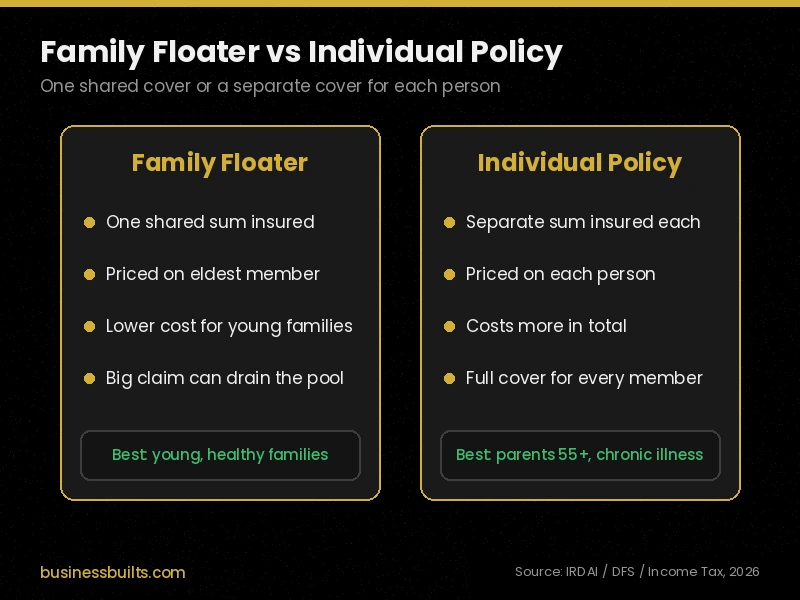
| Feature | Family floater | Individual policy |
| Sum insured | One shared amount for all members | Separate amount for each person |
| Premium basis | Usually priced on the eldest member’s age | Priced on each person’s own age and health |
| Cost for a young family | Lower | Higher |
| Cost when parents are included | Rises sharply | Parents priced separately |
| Risk of cover running out | Higher, one big claim uses the shared pool | Lower, each person is protected on their own |
| No Claim Bonus | Shared by the family | Earned separately by each person |
| Renewals and paperwork | One policy, one date | Multiple policies (unless multi-individual) |
| Best for | Young, healthy nuclear families | Senior members and people with chronic illness |
How Premiums Are Really Calculated
This is the part most floater vs individual policy comparisons skip. Most insurers price a family floater on the age of the eldest member in it. That single rule changes everything.
Real example: Amit’s family of three (32, 30 and 3) fits well in a floater, because the eldest member is 32 and the premium stays low. If Amit adds his 58-year-old father to the same floater, the whole policy is now priced on a 58-year-old’s risk. The family pays a senior-level premium for a cover that is shared by four people, one of whom is statistically the most likely to claim.
The smarter setup for Amit is two policies: a floater for himself, Neha and their son, and a separate individual policy or senior citizen plan for each parent. His parents also get their own full sum insured, instead of competing with a toddler’s hospital bills.
The Claim Scenario That Decides It
Premium is only half the story. What matters is whether the cover holds up in a bad year.
Suppose Amit has a ₹10 lakh floater for his family of three:
| Event in the same policy year | Claim | Cover left for the family |
| Amit’s appendix surgery | ₹2.5 lakh | ₹7.5 lakh |
| Son hospitalised with dengue | ₹1.2 lakh | ₹6.3 lakh |
| Neha’s fracture and surgery | ₹3 lakh | ₹3.3 lakh |
The family is still covered, but only ₹3.3 lakh remains for the next nine months. Two features reduce this risk:
- Restoration or recharge benefit: many floaters refill the sum insured once it is used up during the year. Check whether it applies to the same illness or only to a different member or condition.
- Super top-up: an extra layer that pays after your total claims in a year cross a set deductible (explained below).
With individual ₹10 lakh policies, each of these claims would have hit a different policy, and every member would still have their full cover.
Which One Should You Choose? A Life-Stage Guide

| Your situation | Best choice | Why |
| Single, under 35 | Individual | Nobody to share cover with |
| Young couple, no kids | Floater | Low premium, both healthy |
| Couple with young children | Floater with restoration benefit | Kids rarely have big claims; newborns can be added easily |
| Family plus parents above 55 | Floater for your family + separate policies for parents | Avoids pricing the whole floater on a senior’s age |
| One member has diabetes, heart disease or another chronic illness | Individual for that member | Their frequent claims won’t drain the family pool |
| Large joint family | Two or more smaller floaters, or multi-individual | Spreads risk and keeps premiums balanced |
The Smart Combo: Floater Plus Super Top-Up
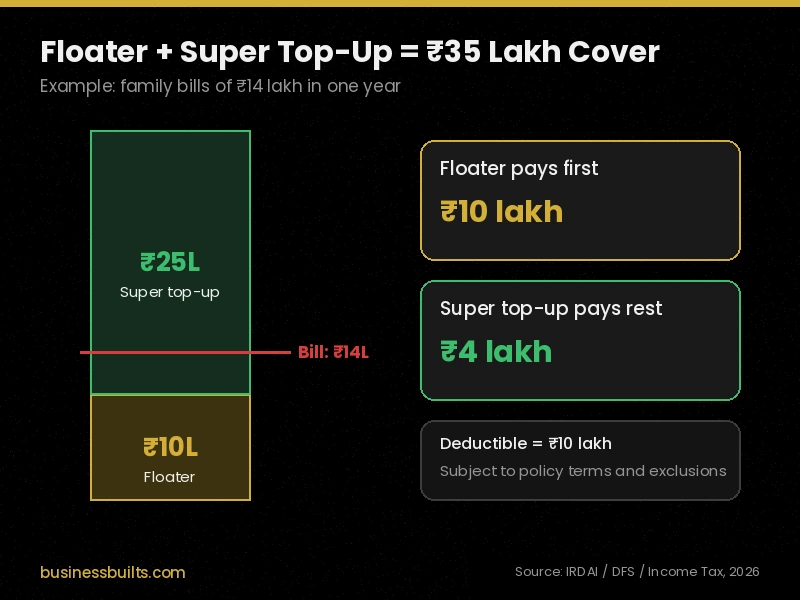
A super top-up policy starts paying once your total medical bills in a policy year cross a deductible. It is much cheaper than raising your base cover, because it only pays for large claims.
Example: Amit keeps a ₹10 lakh family floater and adds a ₹25 lakh super top-up with a ₹10 lakh deductible. If the family’s bills in a year total ₹14 lakh, the floater pays the first ₹10 lakh and the super top-up pays the remaining ₹4 lakh. The family effectively has ₹35 lakh of protection for a premium far lower than a ₹35 lakh base policy.
This combination solves the biggest weakness of a floater, which is a shared pool running dry in a bad year.
2026 Rules That Change the Math

Several changes since 2024 make health insurance cheaper and fairer, and many comparison articles still don’t mention them:
| Rule | What changed | Why it matters for your choice |
| GST on premiums | Cut from 18% to 0% on individual and family floater policies from 22 September 2025 | Both options got cheaper; group or employer policies still carry 18% GST |
| Pre-existing disease waiting period | Capped at 3 years (was up to 4) | A parent with diabetes gets covered sooner in a separate policy |
| Moratorium period | Reduced to 5 years of continuous cover (was 8) | After 5 years, claims can’t be rejected for non-disclosure, except proven fraud |
| Entry age | No maximum age for buying a new policy | You can buy an individual policy for parents at any age |
| Portability and migration | Waiting period credits move with you | You can shift from a floater to individual policies later without restarting waiting periods |
Read our detailed guide on GST for health insurance to see how much the 0% GST saves on your renewal.
Tax Benefit: Section 80D and the New Section 126
Premiums for both floater and individual policies qualify for a tax deduction, but only if you use the old tax regime. Under the Income Tax Act 2025, which applies from tax year 2026-27, Section 80D has become Section 126, with the same limits:
| Who is covered | Maximum deduction |
| Self, spouse and children (all below 60) | ₹25,000 |
| Parents below 60 (extra) | ₹25,000 |
| Parents 60 or above (extra) | ₹50,000 |
| Self or spouse 60 or above | ₹50,000 |
| Preventive health check-up | ₹5,000, within the above limits |
Tax tip: if you pay your parents’ premium through a separate policy, you can claim the parents’ limit on top of your own. Mixing parents into your floater makes it harder to split the premium cleanly between the two limits. Claim it in your return before the ITR filing last date.
Mistakes to Avoid
- Adding senior parents to a young family’s floater. It raises the premium for everyone and puts the most claim-prone members in a shared pool.
- Choosing a sum insured that’s too low. A single major surgery in a private city hospital can cost several lakh. For a family in a metro, ₹10 lakh is a reasonable minimum base, with a super top-up for bigger risks.
- Ignoring room rent limits. A room rent cap can shrink your entire claim proportionally. Prefer plans with no room rent limit or a single private room.
- Forgetting when children age out. Many floaters cover dependent children only up to around 25 years. Plan to move them to their own policy before that.
- Relying only on employer cover. Group cover ends when you change or lose your job. Keep a personal policy running so your waiting periods keep counting.
How to Switch From a Floater to Individual Policies Without Losing Benefits
Under IRDAI’s 2024 Master Circular on Health Insurance, you can move between policies through portability (to another insurer) or migration (to another plan with the same insurer). The credits you have built up, including waiting periods already served and the moratorium period, carry forward to the extent of your previous sum insured.
So if your parents are in a floater today, you can split them into individual policies at renewal without starting their pre-existing disease waiting period from zero. Apply at least 45 days before renewal and ask the insurer to confirm the continuity credits in writing.
Frequently Asked Questions
Family floater lena better hai ya individual policy?
Agar aapki family young hai aur sab healthy hain, to family floater sasta aur kaafi hota hai. Lekin agar ghar me 55 saal se upar ke parents hain ya kisi ko diabetes, BP ya heart ki problem hai, to unke liye alag individual policy lena zyada samajhdari hai. Kai families dono ka combination leti hain.
Kya main apne parents ko family floater me add kar sakta hoon?
Haan, kar sakte ho, lekin ye aksar mehenga padta hai. Zyada tar insurers floater ka premium sabse bade member ki age ke hisaab se lagate hain. Parents add karte hi poore floater ka premium unki age par chala jaata hai. Unke liye alag senior citizen ya individual plan lena usually sasta padta hai.
Floater me ek member ne poora sum insured use kar liya, to baaki ka kya hoga?
Us saal baaki members ke liye cover utna hi bachega jitna claim ke baad reh gaya. Isliye floater lete waqt restoration ya recharge benefit wala plan chuno, jo khatam hua sum insured dobara bhar deta hai. Saath me super top-up lene se bade bills ka risk aur kam ho jaata hai.
Health insurance par ab GST lagta hai kya?
22 September 2025 se individual aur family floater dono tarah ki health policies par GST 0% hai. Pehle ye 18% tha. Company ya group health insurance par abhi bhi 18% GST lagta hai.
Family floater aur individual policy dono par tax chhoot milti hai?
Haan, dono ke premium par tax deduction milta hai, lekin sirf old tax regime me. Apne, spouse aur bachchon ke liye ₹25,000 tak, aur parents ke liye alag se ₹25,000 (senior citizen ho to ₹50,000) tak ka deduction mil sakta hai. Naye Income Tax Act 2025 me ye Section 126 ke naam se hai.
How is family floater premium calculated?
Most insurers calculate the floater premium mainly on the age of the eldest member, along with the number of members, the sum insured, your city and any pre-existing conditions. That is why adding one senior member can raise the premium for the whole family.
Can I convert my family floater into individual policies later?
Yes. Through migration with the same insurer or portability to a new one, you can split a floater into individual policies at renewal. Waiting periods you have already served carry forward up to your earlier sum insured, as per IRDAI rules.
What is the ideal sum insured for a family floater in 2026?
For a family of three or four in a metro city, a ₹10 lakh base floater with a ₹20 to ₹25 lakh super top-up is a practical starting point. Families in smaller cities can start lower, but should still plan for one major surgery a year.
Plan Your Family’s Health Cover the Right Way
Before you pay your next renewal, list every family member’s age and health condition and match it against the life-stage table above. If your parents are in your floater today, ask your insurer for a migration quote to individual policies and compare the total premium. Use our All in One Financial Calculator to fit the premium into your yearly budget, and explore more simple money guides on the BusinessBuilts homepage.
Sources
- IRDAI Master Circular on Health Insurance Business, 29 May 2024, and IRDAI (Insurance Products) Regulations, 2024
- Department of Financial Services, Ministry of Finance: GST exemption on individual life and health insurance policies, effective 22 September 2025
- Income Tax Department: Section 80D, Income-tax Act, 1961, and Section 126, Income Tax Act, 2025
Disclaimer
This article is for general information and educational purposes only and is not insurance, tax or financial advice. Premiums, features, restoration benefits, room rent limits and age limits vary by insurer and plan. Always read the policy wording and customer information sheet, and confirm details with the insurer or a licensed insurance adviser before buying or switching. Tax figures are based on rules available as of September 2026. Read our full Disclaimer.
About the Author
Ashish Kumar is the founder of BusinessBuilts and a finance and business content writer with over five years of experience covering personal finance, banking, insurance, taxation and investments. Every BusinessBuilts article is researched from official sources such as IRDAI, RBI and the Income Tax Department, and updated when the rules change. Read more about BusinessBuilts.
Last updated: 30 September 2026
