



LIC Mutual Fund announced this month that it’s preparing to launch a Specialised Investment Fund with a target corpus of ₹500 crore, expected to go live in October 2026. If that’s the first time you’ve heard the term, you’re not behind, this is a genuinely new product category, and the confusion around what is SIF investment in India is understandable given how recently it actually started existing.
What Is SIF Investment in India? Why SEBI Created a Whole New Category
Before SIFs existed, Indian investors had a genuine gap in their options. Mutual funds are accessible starting from ₹100 through a SIP, but they’re structurally rigid, a fund manager running an equity scheme can only buy stocks, never short them, and has to stick to the allocation pattern defined by the fund’s category. On the other end, Portfolio Management Services offer real flexibility and customization, but the ₹50 lakh minimum investment puts them out of reach for most people who aren’t already quite wealthy.
SEBI acknowledged this gap directly in a July 2024 consultation paper on new asset classes, and moved from proposal to regulation fairly quickly. The formal framework was notified in December 2024, and became applicable from April 1, 2025. The result is the SIF, a middle rung on the ladder that didn’t exist before: more flexibility than a mutual fund, a meaningfully lower entry point than PMS.
SIF vs Mutual Fund vs PMS: Where Each One Sits
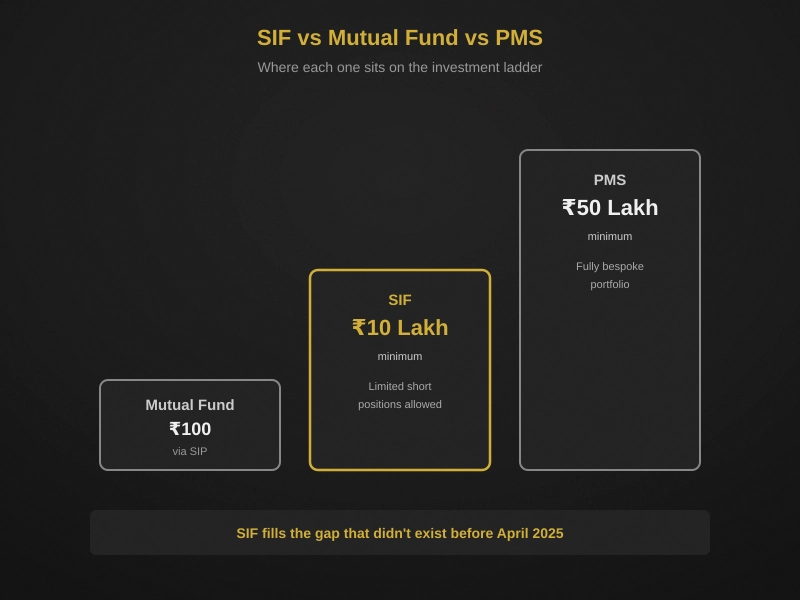
Understanding SIF vs mutual fund vs PMS comes down to three factors, entry cost, flexibility, and who’s actually managing your money day to day.
| Feature | Mutual Fund | SIF | PMS |
| Minimum investment | ₹100 (via SIP) | ₹10 lakh | ₹50 lakh |
| Can take short positions | No | Yes, within limits | Yes, fully customizable |
| Portfolio structure | Fixed by fund category | Strategy-driven, more flexible | Fully bespoke per client |
| Regulatory framework | SEBI Mutual Fund Regulations | SEBI Mutual Fund Regulations (amended) | SEBI PMS Regulations |
| Distributor qualification | Standard MF certification | NISM Series-XIII Derivatives Certification | Not applicable, direct client relationship |
| Typical investor profile | Retail, all experience levels | HNIs comfortable with market-linked risk | Ultra-HNI, fully personalized needs |
The single biggest structural difference, more than the money involved, is what the fund manager is actually allowed to do. A standard equity mutual fund manager can only go long, buying stocks and holding them. An SIF manager running a long-short strategy can also take limited short positions through derivatives, betting against a stock or sector within SEBI’s prescribed limits. That’s a fundamentally different toolkit, and it’s why SIFs get compared more to hedge-fund-style strategies than to a typical equity fund, even though they’re still regulated under the same broad mutual fund framework.
SIF Minimum Investment: The ₹10 Lakh Rule, Explained Properly
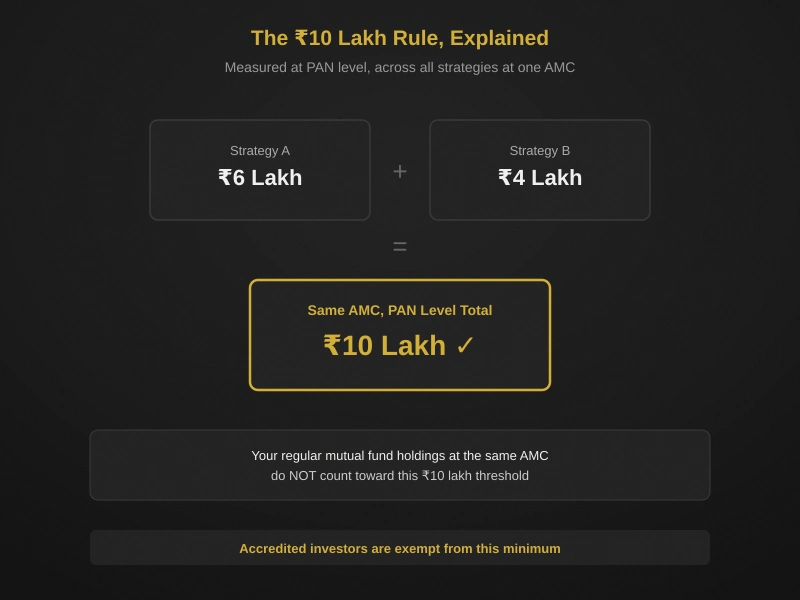
The sif minimum investment threshold works a little differently than people often assume. It’s ₹10 lakh at the PAN level, meaning it’s measured across all SIF strategies offered by a single fund house, not per individual scheme. If you invest ₹6 lakh in one SIF strategy and ₹4 lakh in another strategy from the same AMC, you’ve met the threshold. This requirement also doesn’t include any money you already have in that AMC’s regular mutual fund schemes, SIF and mutual fund investments are counted separately.
There’s one notable exception: accredited investors, a SEBI-defined category of individuals who meet specific income or net worth criteria, are exempt from the ₹10 lakh minimum entirely.
The Rules That Keep SIFs From Becoming Unregulated Bets
It’s worth being clear that “more flexible” doesn’t mean “unrestricted.” SEBI specialised investment fund rules still impose real guardrails. No SIF can allocate more than 20% of its net asset value to debt instruments from a single issuer, unless those instruments are investment grade or better. Concentration limits on individual securities apply too, generally capping exposure to any single security at a defined percentage of the fund’s assets, so a fund manager can’t simply bet the entire corpus on one stock or one bond issuer.
There’s also a distribution safeguard worth knowing about: anyone selling or advising on SIF products needs to have passed the NISM Series-XIII Common Derivatives Certification Exam, a meaningfully higher qualification bar than what’s required to distribute a standard mutual fund. That’s SEBI’s way of ensuring the people recommending these products actually understand the derivative exposure involved before they’re advising clients on it.
Who Should Actually Consider an SIF
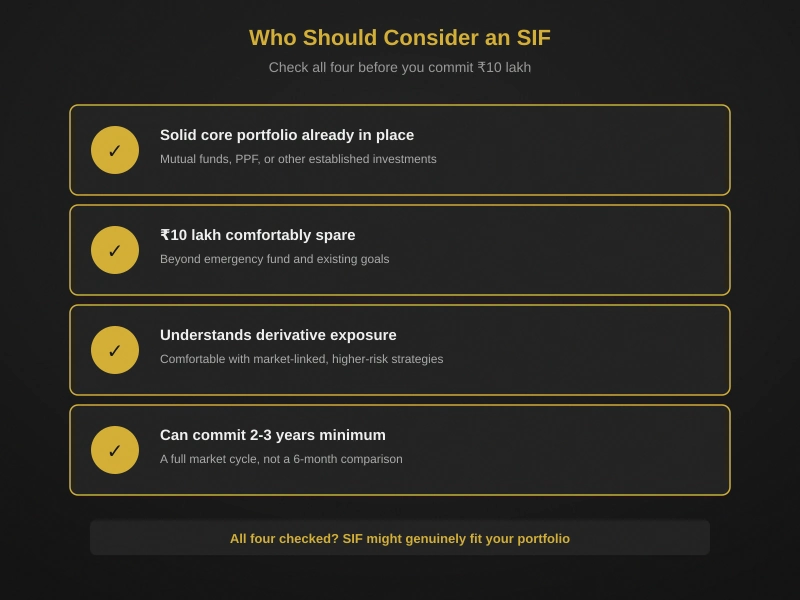
This isn’t a product for someone just starting their investing journey, and it’s worth being honest about that rather than treating every new product as universally beneficial. SIFs make sense for investors who already have a solid base of conventional investments, whether that’s mutual funds or PPF and other guaranteed-return instruments, and are looking to allocate a smaller, satellite portion of their portfolio toward a more sophisticated, higher-risk strategy.
You should also be planning to hold for a genuine market cycle, typically a minimum of two to three years, since strategy-driven products with derivative exposure can look wildly different from a plain equity fund over any short window like six months. Comparing an SIF’s six-month return against a mutual fund’s six-month return isn’t a meaningful comparison, and judging the product that way is a common mistake early investors make.
If you’re still building your core portfolio, paying down debt, or don’t yet have ₹10 lakh comfortably allocated beyond your emergency fund and existing goals, this almost certainly isn’t the right entry point yet. There’s no urgency here, SIFs aren’t going anywhere, and the fund houses currently offering them (DSP, and soon LIC Mutual Fund among others) will still be around once your financial foundation is solid enough to consider adding one.
What This Looks Like in Practice
A handful of fund houses had SEBI’s approval to launch SIF products as of mid-2025, and that list has been growing steadily through 2026. DSP Mutual Fund’s “Endurance SIF” is one example already live in the market. LIC Mutual Fund’s upcoming launch, targeting a ₹500 crore corpus, is expected around October 2026, and reflects the broader industry momentum behind this category as more established fund houses build out SIF offerings alongside their traditional mutual fund lineups.
Frequently Asked Questions
What is SIF investment in India?
To answer what is SIF investment in India directly: it’s a SEBI-regulated investment category, effective since April 1, 2025, that sits between mutual funds and Portfolio Management Services. It requires a ₹10 lakh minimum investment and allows fund managers more flexible strategies, including limited short positions, than a standard mutual fund permits.
What is the minimum investment for an SIF?
₹10 lakh, measured at the PAN level across all SIF strategies offered by a single fund house. This threshold doesn’t include your existing investments in that AMC’s regular mutual fund schemes, and accredited investors are exempt from this minimum.
How is an SIF different from a mutual fund?
The core difference is what the fund manager can do. A standard mutual fund manager can only take long positions, buying and holding. An SIF manager can use limited derivative strategies, including short positions, within SEBI’s prescribed regulatory limits.
SIF investment kya hota hai India mein?
SIF investment India mein ek SEBI-regulated category hai, jo 1 April 2025 se effective hai, aur mutual funds aur PMS ke beech mein hai. Isme minimum ₹10 lakh invest karna padta hai, aur fund manager ko mutual fund se zyada flexible strategies use karne ki permission hoti hai.
SIF ka minimum investment kitna hai?
₹10 lakh, jo PAN level pe measure hota hai, ek hi fund house ke saare SIF strategies mile ke. Yeh threshold aapke existing mutual fund investments include nahi karta, aur accredited investors ko is minimum se exempt kiya gaya hai.
SIF aur mutual fund mein kya farak hai?
Sabse bada farak yeh hai ki fund manager kya kar sakta hai. Regular mutual fund manager sirf long position le sakta hai, matlab sirf khareed ke hold kar sakta hai. SIF manager limited derivative strategies use kar sakta hai, jisme short positions bhi shamil hai, SEBI ke defined limits ke andar.
Kya SIF mein invest karna chahiye?
Sirf un investors ke liye jo already conventional investments mein solid base rakhte hai, jinke paas ₹10 lakh higher-risk strategy ke liye allocate karne layak hai, aur jo 2-3 saal ka evaluation horizon commit kar sakte hai.
Building a Balanced Investment Portfolio?
Before considering a specialized product like SIF, it’s worth having your core investments in place. Our Best Mutual Funds to Invest in 2026 guide and Direct vs Regular Mutual Fund breakdown cover the foundational choices most investors should settle first.
Disclaimer: This guide is for informational and educational purposes only and does not constitute investment advice. Specialised Investment Funds involve relatively higher risk, including potential loss of capital, liquidity risk, and market volatility. Always read scheme-related documents carefully and consult a SEBI-registered investment advisor before investing.
About the Author
Ashish Kumar is a finance and business content writer with over 5 years of experience specializing in personal finance, banking, insurance, taxation, investments, fintech, and business trends. Through BusinessBuilts, he publishes well-researched, accurate, and easy-to-understand content based on credible sources and the latest industry developments to help readers make informed financial decisions.
