


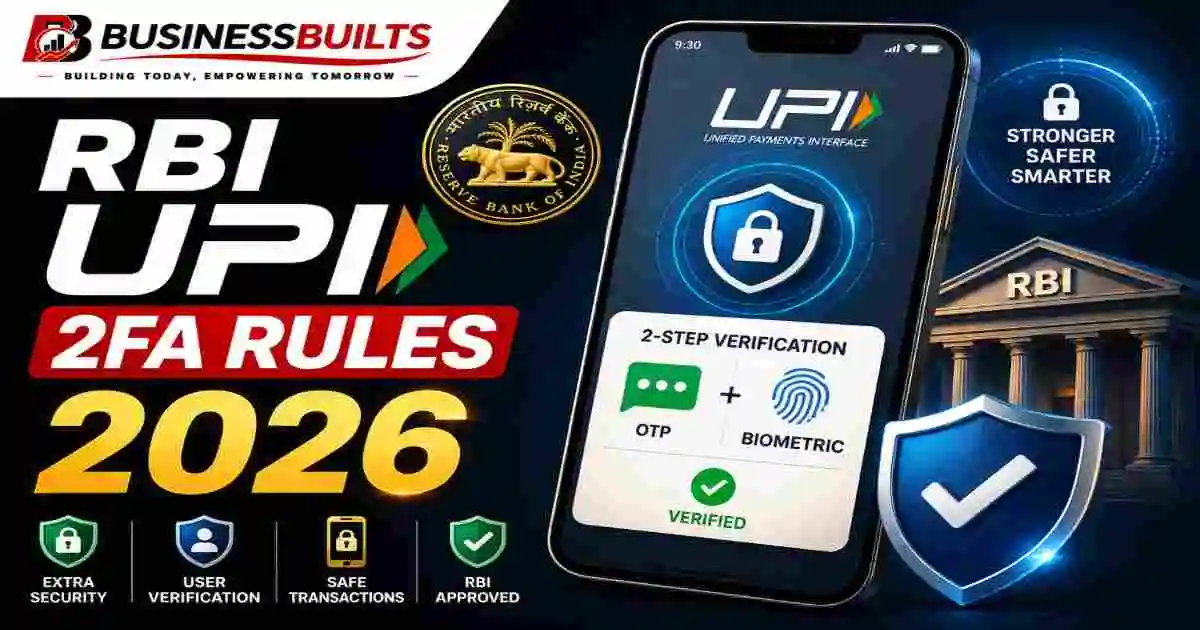
RBI UPI 2FA rules 2026 are the reason your UPI app has been asking for an extra tap, a fingerprint, or a device confirmation lately, on top of the PIN you’re used to entering. If you’ve noticed payments feeling slightly different since earlier this year and wondered whether something broke, nothing broke. This is a deliberate, mandatory security upgrade, and it’s worth understanding exactly what it does.
Why RBI Decided One Layer of Security Wasn’t Enough Anymore
For years, the OTP delivered by SMS was the backbone of digital payment security in India. It worked, mostly, because it was simple and nearly everyone had a phone that could receive a text message. But simplicity has a cost. As digital payment volumes exploded, so did the sophistication of fraud built specifically to exploit OTP-only systems.
SIM-swap fraud, where a criminal convinces a telecom provider to transfer your number to their SIM, became a genuine, repeated threat. Phishing sites that mimic real bank pages to harvest OTPs got harder to spot. And because an OTP by itself proves nothing except that someone received a text message, once a fraudster had it, they had everything they needed to complete a transaction. The RBI’s response, formally called the Authentication Mechanisms for Digital Payment Transactions Directions, 2025, is the backbone of these rbi digital payment rules 2026, closing that single point of failure by requiring a second, independent factor.
RBI UPI 2FA Rules 2026: What “Two-Factor” Actually Means

Security systems generally group authentication into three categories: something you know (a PIN or password), something you have (your phone, a hardware token, or a registered device), and something you are (a fingerprint or facial scan). This is the foundation of upi two factor authentication, and under the new rules, every digital payment now needs at least two of these three categories confirmed before it goes through.
Crucially, at least one of those factors has to be dynamic, generated specifically for that one transaction and useless the moment it’s used or it expires. A static PIN alone doesn’t qualify anymore as your only line of defence, because a static credential that never changes is exactly what fraud is built around exploiting.
An OTP can still be part of the mix. What’s changed is that it can no longer be the only thing standing between your money and a transaction. Banks are now combining OTPs with biometrics, secure device tokens, or in-app approval prompts, so if you’ve noticed your banking app asking you to approve a payment with a fingerprint tap instead of typing in a code, that’s this rule in action.
How This Plays Out Across UPI, Cards, and Wallets

These upi authentication changes apply uniformly, but the day-to-day experience differs slightly depending on how you’re paying.
UPI transactions now typically require device binding or app-level verification alongside your UPI PIN, meaning the app itself needs to confirm it’s genuinely your registered device making the request, not just that someone typed the correct PIN, in line with NPCI’s UPI guidelines. A similar caution applies when verifying suspicious messages, like the kind covered in our fake PhonePe transaction guide, since no authentication rule protects you if you approve something you shouldn’t have.
Card transactions, whether online or at a point-of-sale terminal, now route through two independent verification steps. You might authenticate with a PIN plus a device token, or a PIN plus biometric confirmation, instead of a PIN and a one-time SMS code.
Recurring payments, like your SIPs, insurance premiums, or OTT subscriptions, work a little differently through a related update, the Digital Payments e-Mandate Framework 2026. Once you set up a recurring payment with one-time additional factor authentication, payments up to ₹15,000 can process automatically afterward, without needing a fresh OTP every single cycle. That’s actually a convenience win buried inside a security-focused reform, similar to how our SBI Contra Fund breakdown discusses systematic investing, and worth knowing if you’ve been wondering why some of your subscriptions stopped pinging you for approval every month.
What Hasn’t Changed

It’s easy to assume a security overhaul like this comes with new restrictions on how much or how often you can pay. It doesn’t, at least not on the transaction limit side. Daily UPI transaction limits remain at ₹1 lakh for most users, with higher limits still available only for specific categories like certain merchant payments or capital market transactions. UPI itself also remains free for personal use, this reform is about verification, not about fees or caps, similar to how balance-check services like our UCO Bank missed call balance check guide remain free and unaffected by this change.
Your existing UPI PIN and card PIN also haven’t been replaced. They’re still very much part of the process, just no longer sufficient on their own.
What You Should Actually Do About This
Honestly, for most people, very little. If your bank or UPI app has already prompted you to set up biometric authentication or link a device token, doing so once means you likely won’t notice much friction going forward, the extra factor often runs quietly in the background as a fingerprint tap rather than an extra typing step. If you haven’t been prompted yet and you’re still seeing pure OTP flows on every transaction, it’s worth checking your UPI app’s security settings, since biometric or device-based authentication tends to be faster in daily use once it’s set up.
One practical habit worth building either way: if you ever get a payment approval request you didn’t initiate, whether it’s a biometric prompt or an in-app confirmation, don’t approve it. The entire point of this reform is to make sure a code alone can’t authorize a payment, but that protection only holds if you don’t approve prompts you don’t recognize. And if you’re managing multiple bank accounts, understanding what a joint account means for shared authentication is worth knowing too, since these 2FA rules apply per registered device, not per account holder.
Frequently Asked Questions
What are the RBI UPI 2FA rules 2026?
They’re new mandatory security requirements under the RBI UPI 2FA rules 2026, effective April 1, 2026, requiring every digital payment in India (UPI, cards, and wallets) to use two independent authentication factors, with at least one being dynamically generated for that specific transaction, instead of relying on an OTP alone.
Do I still need my UPI PIN under the new rules?
Yes. Your UPI PIN remains one of the required authentication factors. It’s now paired with a second factor, such as biometrics, a device token, or an in-app approval, rather than working alone.
Has my daily UPI transaction limit changed?
No. Daily UPI limits remain at ₹1 lakh for most users. This reform changes how transactions are verified, not how much you can transact.
Can I still use OTP for UPI or card payments?
Yes, but an OTP alone is no longer sufficient. It can serve as one of your two required authentication factors, but it must be paired with a second, independent factor like biometrics or a device-based confirmation.
RBI UPI 2FA rules 2026 kya hai?
Yeh naye mandatory security rules hai, jo RBI UPI 2FA rules 2026 ke naam se jaane jaate hai, 1 April 2026 se effective, jinke under har digital payment, UPI ho ya card ho, ab do independent authentication factors se verify hoga, sirf OTP se nahi.
Kya UPI PIN abhi bhi kaam karega?
Haan, UPI PIN abhi bhi zaroori hai. Bas ab isके saath ek aur factor bhi chahiye hoga, jaise biometric ya device confirmation, akela PIN kaafi nahi hai.
Kya UPI ki daily limit change hui hai?
Nahi, daily UPI limit ₹1 lakh hi rahegi zyadatar users ke liye. Yeh reform sirf verification process change kar raha hai, transaction limit nahi.
Keeping Your Digital Finances Secure?
Setting up biometric authentication is just one part of good financial hygiene. Check if you’ve spotted fake PhonePe transaction scams before, and if you’re planning recurring investments that now benefit from the smoother e-mandate process, our SIP Calculator and Best Mutual Funds to Invest in 2026 guide are good next reads.
Disclaimer: This guide is for informational purposes only and does not constitute financial or security advice. RBI guidelines and their implementation timelines can be updated. Always verify current requirements through your bank’s official communication or the RBI’s official website.
About the Author
Ashish Kumar is a finance and business content writer with over 5 years of experience specializing in personal finance, banking, insurance, taxation, investments, fintech, and business trends. Through BusinessBuilts, he publishes well-researched, accurate, and easy-to-understand content based on credible sources and the latest industry developments to help readers make informed financial decisions.
