


Last updated: July 2026 | Written by Ashish Kumar, Founder at BusinessBuilts
Every “best mutual fund” article you’ll find right now does the same thing: a table, some star ratings, a handful of fund names, done. That’s not wrong, exactly. It’s just incomplete. A fund that’s “best” for a 26-year-old with a 20-year runway can be a genuinely bad fit for someone five years from retirement, even if both funds have five stars sitting next to their name.
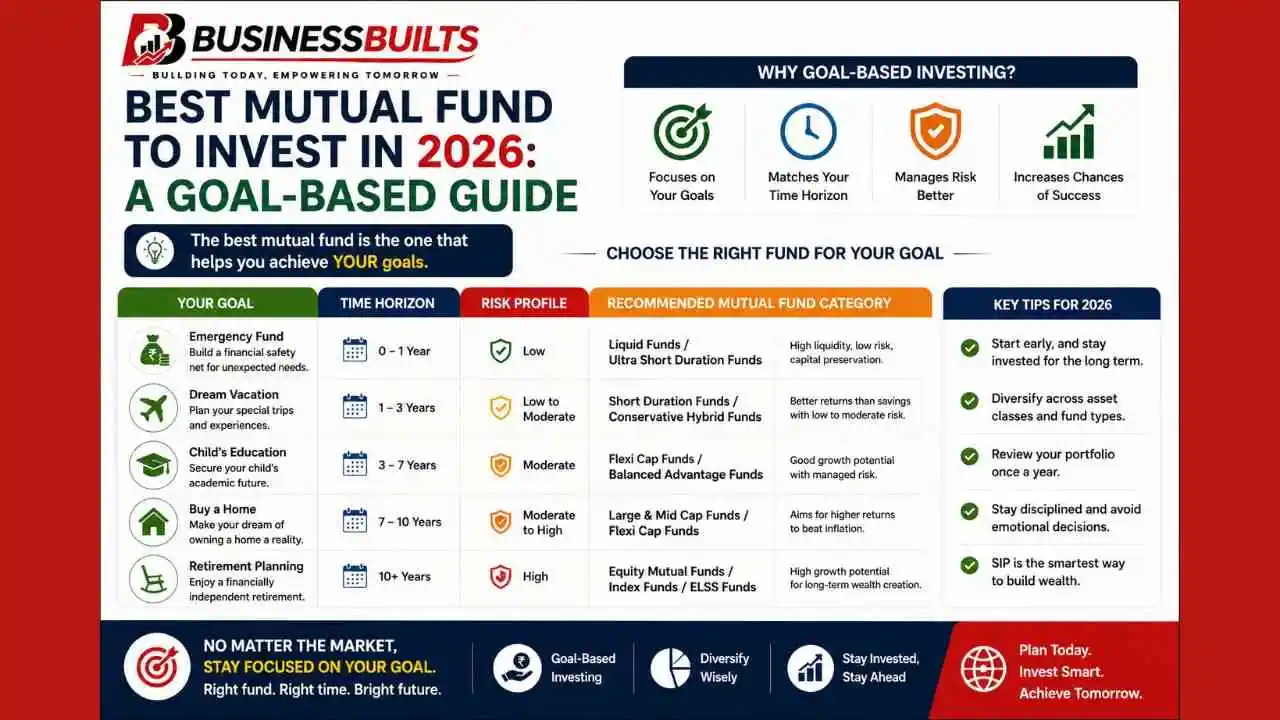
At BusinessBuilts, we get asked this question constantly, so instead of handing you another ranked list, this guide starts where the decision actually starts: with you. Ask “what’s the best mutual fund to invest in 2026” and the honest answer is: it depends on your goal, your timeline, and how you’d actually react if your portfolio dropped 15% in a month. Get that right, and the best mutual fund to invest in 2026, for your situation specifically, mostly picks itself.
Is 2026 a Good Year to Invest in Mutual Funds?
Short answer: yes, with the usual caveats that apply every year. Stay invested for the long haul, don’t chase last month’s winner.
For anyone researching the best mutual fund to invest in 2026 in India, the backdrop matters as much as the fund itself. India’s mutual fund industry has crossed ₹65 lakh crore in AUM in early 2026, and SIP accounts have gone past 10 crore, with monthly SIP inflows holding above ₹25,000 crore. That’s not a fluke. It’s a decade of habit formation finally showing up in the numbers. Equity markets went through real volatility in 2024-25 and again briefly in early 2026 around global oil and geopolitical shocks, but interestingly, retail money didn’t flee. Equity funds kept seeing inflows through the dip, while debt funds saw structural outflows (mostly institutional cash management around financial year-end, not panic).
One thing worth knowing about if you haven’t heard of it yet: Specialized Investment Funds (SIFs), a newer category that sits between traditional mutual funds and portfolio management services, with more flexible investment mandates and a higher entry ticket. If you’re an experienced investor with surplus capital, it’s worth a look, but for most people reading this, regular mutual funds still make more sense because of the lower entry barrier and better liquidity.
The bigger 2026-specific thing to know: several AMCs have paused or restricted fresh lump-sum inflows into some of their most popular small-cap schemes because they’re getting too large to deploy efficiently in a smaller-cap universe. If a small-cap fund you’re eyeing shows “SIP only” or “restricted,” that’s not a red flag on the fund. It’s actually a sign the AMC is managing capacity responsibly. But it does mean your shortlist might need a backup option.
Why “Best Mutual Fund” Is the Wrong Question to Start With

Here’s the thing nobody tells you upfront: there is no single best mutual fund to invest in 2026 that works for everyone. There’s a best fund for your situation, and that changes based on three inputs: your goal, your time horizon, and how much short-term pain you can tolerate for long-term gain.
Star ratings are a good first filter, not a final answer. A 5-star large-cap fund and a 4-star large-cap fund in the same category often have return differences of under 1% annually, but very different portfolio concentration, sector bets, and volatility patterns. Ratings tell you a fund has been a solid performer relative to its category. They don’t tell you whether that category, or that specific fund’s style, fits you.
That’s why the next section matters more than any list of fund names.
Find Your Investor Profile (Decision Framework)
Answer these three questions honestly before you look at a single fund name:
- What’s the goal? Retirement, a house down payment in 3 years, your kid’s college fund in 12 years, or just “grow my money”?
- What’s the time horizon? Under 3 years = short-term. 3-7 years = medium-term. 7+ years = long-term.
- How would you actually react to a 20% drop? Not how you think you’d react, but how you actually have, if you’ve invested before.
Match yourself to one of these profiles:
The first-time investor, still building confidence You’re new to equity investing, maybe just started your first SIP. Stick to large-cap or index funds. The volatility is lower and it gives you time to build conviction without a rough first year souring you on investing altogether. A large-cap fund like Nippon India Large Cap or a low-cost index option like ICICI Prudential Nifty 50 Equal Weight Index are reasonable starting points. The index fund route in particular removes manager-selection risk entirely while you’re still learning.
The long-term wealth builder (7+ years, moderate risk appetite) If you’re looking for the best mutual fund to invest in 2026 for long term goals, this is probably your profile. This is the largest group of investors, and flexi-cap or multicap funds suit it well because the fund manager has the freedom to move across large, mid, and small caps as opportunities shift, instead of being boxed into one segment. Parag Parikh Flexi Cap Fund stands out here for its international exposure and concentrated, quality-focused portfolio. It holds far fewer stocks than most flexi-cap peers, which is a genuine differentiator, not just marketing language. HDFC Flexi Cap takes a more diversified approach with a longer track record.
The aggressive, young earner with a long runway If you’re in your 20s or early 30s with 10+ years before you’ll need the money, and you’ve already got some equity investing experience, mid-cap and small-cap funds can meaningfully boost returns, at the cost of much rougher rides along the way. Motilal Oswal Midcap Fund has had strong recent performance with a high-conviction, concentrated style. In small caps, check first whether your target fund is accepting fresh lump-sum investments given the capacity restrictions mentioned earlier.
The goal-based investor (education fund, retirement 10+ years out) When there’s a hard deadline attached to the money, a pure equity fund can be risky in the final stretch. A bad year right before you need the money can set you back badly. Hybrid or balanced advantage funds, which dynamically shift between equity and debt based on market valuations, smooth this out. HDFC Balanced Advantage Fund is a well-known name in this category, precisely because it automates the de-risking decision instead of leaving it to your timing (which, statistically, tends to be bad).
The tax-saver If Section 80C tax-saving is your priority alongside growth, ELSS funds are your category. They come with the shortest lock-in (3 years) of any tax-saving instrument, and being equity-oriented, historically outperform PPF or tax-saving FDs over the long run, though obviously with more volatility.
Best Mutual Fund Categories to Watch in 2026

Large Cap Funds
Best for: stability-first investors, first SIPs, core portfolio holding These invest at least 80% in India’s top 100 companies by market cap. You won’t get explosive returns, but you also won’t lose sleep. Index funds tracking Nifty 50 or Nifty 100 are increasingly competitive with actively managed large-cap funds here. The category has gotten hard for active managers to beat consistently, which is itself useful information if you’re deciding between active and passive.
Mid Cap Funds
Best for: 5-7+ year horizon, moderate-to-high risk tolerance Mid caps sit in the sweet spot between large-cap stability and small-cap volatility, established enough to have some track record, small enough to still have real growth room. This category has benefited strongly from India’s domestic consumption growth and the rise of new-age businesses over the past several years.
Flexi Cap / Multicap Funds
Best for: investors who want one fund that adapts, rather than manually rebalancing across categories themselves The manager decides the large/mid/small split based on where they see opportunity. This flexibility is genuinely valuable in a market like 2026’s, where valuations across segments haven’t moved uniformly.
Small Cap Funds
Best for: 7+ year horizon, high risk tolerance, and, this year specifically, investors willing to check fund capacity status before committing Small caps can deliver the highest long-term returns of any equity category, and also the sharpest drawdowns. Nippon India Small Cap Fund carries the largest AUM in the category; SBI Small Cap Fund has been one of the more consistent performers. Given 2026’s capacity constraints in this segment, confirm the fund is open to the investment mode you want (SIP vs. lump sum) before you finalize your choice.
ELSS (Tax-Saving) Funds
Best for: 80C tax planning combined with equity growth Three-year lock-in, equity exposure, tax deduction: a genuinely efficient combination if you’re going to invest anyway.
Hybrid / Balanced Advantage Funds
Best for: goal-based investing with a fixed timeline, or investors who want equity exposure with a shock absorber built in These funds move their equity-debt mix based on market valuation signals, which takes some of the emotional decision-making out of your hands, often a good thing.
Why Two Funds With the Same Star Rating Can Perform Very Differently

This is the part most “best funds” lists skip entirely, and it’s arguably the most useful thing you can learn before picking a fund.
Two large-cap funds can both carry a 4-star rating and still behave completely differently in a downturn. Why? A few reasons:
Portfolio concentration. A fund holding its top 10 stocks at 70% of the portfolio will swing harder, up and down, than one spreading the same capital across 40 names. Parag Parikh Flexi Cap, for example, runs a noticeably more concentrated book than most flexi-cap peers; that’s part of why its returns and its dips both tend to be sharper.
Downside capture ratio. This tells you what percentage of a market fall the fund actually experienced. A fund with a downside capture of 85% lost less than the market during downturns; one at 110% lost more. Two funds with near-identical upside can have very different downside numbers, and that’s the number that determines how well you sleep during a correction.
Manager tenure and churn. A fund that’s changed managers twice in three years carries execution risk that a rating alone won’t show you. Check how long the current manager has actually run the fund, not just how long the fund itself has existed.
Sector tilt. A “large cap” fund overweight on banking and financials will move very differently from one tilted toward IT or consumption, even though both are technically the same category.
The takeaway: use the star rating to narrow your list to 8-10 candidates, then look at these four factors to pick the one that actually fits you.
The Cost Mistake Most Investors Don’t See: Direct vs Regular Plans

Here’s a number that should bother you more than it probably does: the difference between a direct plan and a regular plan of the same fund is typically 0.5% to 1.5% in expense ratio, every single year, for as long as you stay invested.
Let’s make that concrete. Say you invest ₹10,000/month via SIP for 15 years, and the fund itself delivers a gross 12% annual return.
- Regular plan (1.8% expense ratio, ~10.2% net return): your corpus grows to roughly ₹40.9 lakh
- Direct plan (0.5% expense ratio, ~11.5% net return): your corpus grows to roughly ₹47.6 lakh
That’s a gap of nearly ₹6.7 lakh on the exact same fund, same market performance, same SIP amount. The only difference is who’s taking a cut for distribution. Direct plans skip the distributor commission entirely, which is why the expense ratio, and your final corpus, looks so different.
If you’re comfortable doing your own research (which, if you’ve read this far, you clearly are), direct plans are almost always the better economic choice. Regular plans make sense mainly if you genuinely want an advisor’s ongoing guidance and are willing to pay for it.
Are You Over-Diversified? How to Check Fund Overlap
If you already hold 6, 8, or 10 mutual funds, here’s an uncomfortable question: how many of them are actually invested in the same stocks?
It’s extremely common to hold two or three “different” flexi-cap or large-cap funds from different AMCs, only to discover they own 60-70% of the same top holdings. Reliance, HDFC Bank, ICICI Bank, and Infosys show up in nearly every large-cap-oriented portfolio in India. When that happens, you’re not diversifying. You’re just paying multiple expense ratios for what is functionally one fund.
To check: pull up the portfolio holdings (top 10-15 stocks) of each fund you hold (every AMC publishes this monthly) and compare them side by side. If two funds share more than half their top holdings by weight, you likely don’t need both. A cleaner portfolio usually looks like 3-5 funds spread across genuinely different categories (say, one large-cap or index fund, one flexi-cap, one mid or small-cap, and one debt/hybrid fund) rather than eight funds that all quietly hold the same 20 stocks.
How to Actually Choose a Mutual Fund (Step-by-Step)
- Define the goal and horizon first, before you look at a single fund name or return chart.
- Match category to horizon and risk tolerance using the profile framework above.
- Shortlist 8-10 funds in that category using star ratings as your first filter.
- Narrow to 2-3 by comparing downside capture ratio, portfolio concentration, and manager tenure.
- Choose the direct plan unless you have a specific reason to pay for advisory support.
- Check for overlap with funds you already hold before adding a new one.
- Set a review cadence, once or twice a year, or when your goals or risk profile genuinely change. Not every time the market has a bad week.
Ready to put this into practice? Use a SIP calculator to model your own goal-based portfolio, or talk to a SEBI-registered advisor at BusinessBuilts if you’d rather get personalized guidance.
Frequently Asked Questions
What are the best mutual fund to invest in 2026?
There’s no single best fund. The right choice depends on your goal, time horizon, and risk tolerance. Large-cap and index funds suit conservative, short-to-medium-term investors; flexi-cap and multicap funds suit long-term wealth builders; mid-cap and small-cap funds suit aggressive investors with 7+ year horizons.
What’s the best mutual fund to invest in 2026 for long term wealth creation?
For long-term goals of 7 years or more, flexi-cap and multicap funds are generally the strongest starting point because the fund manager can shift across large, mid, and small caps as opportunities change. Within that, look at portfolio concentration and downside capture ratio, not just the headline return, to find the one that matches your risk comfort.
What are the best mutual funds to invest in 2026 lumpsum vs SIP?
SIP remains the more reliable approach for most investors because it removes the guesswork of timing the market and builds discipline. For a lump sum specifically, valuation matters more since you’re deploying all your money at once. Balanced advantage funds, which automatically adjust their equity-debt mix based on market valuations, are often a safer lump-sum entry point than a pure equity fund. Staggering a large lump sum into equity over 3-6 months through an STP (systematic transfer plan) is another common way to reduce timing risk.
What is a Specialized Investment Fund (SIF)?
SIFs are a newer investment category that sits between traditional mutual funds and portfolio management services, offering more flexible mandates with a higher minimum investment. They’re generally more suitable for experienced investors with larger surplus capital rather than first-time or moderate-ticket investors.
Are small-cap funds still open for new investors in 2026?
Many are, but several AMCs have restricted fresh lump-sum inflows into their most popular small-cap schemes due to capacity concerns, while continuing to accept SIPs. Always check a fund’s current investment status before committing.
How much does expense ratio difference actually matter?
More than most investors realize. A 1-1.3% annual difference between a direct and regular plan of the same fund can compound into a gap of several lakh rupees over a 15-year SIP, purely from the cost difference, not from any change in the fund’s actual performance.
Direct vs regular plan: which should I choose?
Direct plans have a lower expense ratio because they skip distributor commissions, which means more of your money stays invested and compounds. Choose direct if you’re comfortable researching and selecting funds yourself; choose regular only if you specifically want an advisor’s paid guidance.
How many mutual funds should I hold in my portfolio?
For most investors, 3-5 well-chosen funds across genuinely different categories is enough. Holding 8-10 funds often just means paying multiple expense ratios for portfolios that heavily overlap in their underlying stock holdings.
About the Author
Written by Ashish Kumar, Founder at BusinessBuilts
Ashish Kumar is the founder of BusinessBuilts, where he writes fact-checked guides on business, finance, and technology topics for everyday readers. He double-checks facts, figures, and claims before publishing, and updates older articles whenever new, verifiable information becomes available.

1 Comment
Pingback: Direct vs Regular Mutual Fund: Which Is Better in 2026?