


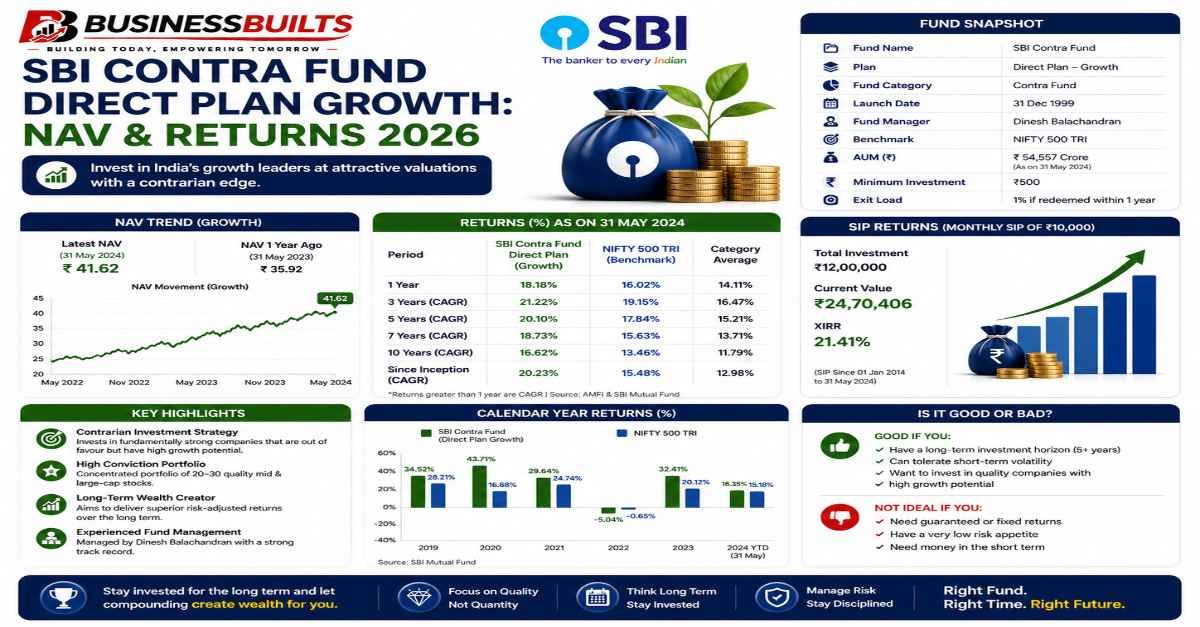
If you’ve landed here, you’re probably staring at a fund fact sheet full of numbers and wondering what half of it actually means for your money. Fair enough, most pages on SBI Contra Fund Direct Plan Growth read like a spreadsheet with a headline slapped on top. At BusinessBuilts, we’d rather tell you what the numbers actually mean, where this fund can genuinely help your portfolio, and where it might just be dead weight next to something you already own.
Here’s the quick answer if you’re short on time: SBI Contra Fund Direct Plan Growth is a high-risk, high-conviction equity fund that bets on stocks the market has temporarily written off. It’s run by Dinesh Balachandran, one of SBI Mutual Fund’s more experienced value investors, and it’s built for people who can stomach volatility and stay invested for at least 5-7 years. It is not a fund for someone who panics when their portfolio is red for six months straight.
Let’s get into the details.
What Is SBI Contra Fund Direct Plan Growth?
SBI Contra Fund Direct Plan Growth is an open-ended equity mutual fund from SBI Mutual Fund that follows a contrarian, value-oriented investment style. “Direct Plan” means you’re buying it straight from the AMC or a direct platform without a distributor taking a commission cut. “Growth” means your returns get reinvested into the fund instead of being paid out as dividends, your NAV grows, you don’t get periodic payouts.
The fund itself isn’t new. It was actually launched way back on 29 June 1987, making it one of the older equity schemes in the Indian market, though its “contra” identity in its current form took shape after SEBI’s 2018 fund categorization rules forced AMCs to clean up overlapping schemes. SBI folded some of its value-style funds into this one around that period, which is worth knowing because it means pre-2018 return history isn’t a clean comparison to what the fund does today.
One thing people search for constantly is the SBI Contra Fund Direct Plan Growth NAV. NAV (Net Asset Value) is simply the per-unit price of the fund, and it moves every business day based on how the underlying stocks perform. As of this writing, the NAV sits in the ₹400-₹406 range, but by the time you’re reading this it will have changed. Always pull the live number from the official SBI Mutual Fund scheme page or AMFI India rather than relying on a screenshot from any article, including this one.
Here’s the fund at a glance (figures move daily, so treat these as a snapshot rather than gospel, always check the SBI Mutual Fund website or AMFI for the live NAV before you invest):
| Detail | Value |
| Category | Equity, Value/Contra Oriented |
| Fund Manager | Dinesh Balachandran (since May 2018) |
| Launch Date | 29 June 1987 |
| Benchmark | BSE 500 Total Return Index |
| Risk Level | Very High |
| Minimum SIP | ₹500 |
| Minimum Lumpsum | ₹5,000 |
| Expense Ratio (Direct) | ~0.6%–1.0% |
| Exit Load | 0.25% if redeemed within 30 days, 0.10% between 30-90 days |
| AUM | Roughly ₹47,000+ crore |
| Rating | 5-star (Value Research) |
Dinesh Balachandran isn’t a rookie here, he’s a B.Tech from IIT Bombay, holds an M.S. from MIT, is a CFA charterholder, and previously worked at Fidelity Investments in the US before joining SBI Funds Management. That background matters more than it sounds like it should, because contrarian investing requires exactly the kind of patient, research-heavy conviction that fund houses look for when picking who runs a value fund.
What Does “Contra” Actually Mean in This Fund’s Strategy?
Every fund page will tell you this fund follows “a contrarian investment strategy to identify undervalued stocks.” That sentence tells you nothing. So let’s actually unpack it.
Contrarian investing means buying stocks that the broader market currently dislikes, ignores, or has beaten down, not because the company is broken, but because sentiment has turned against it temporarily. The bet is that sentiment eventually corrects and price catches up with underlying value. It’s the opposite of chasing whatever’s hot.
You can see this philosophy playing out in the fund’s actual holdings, not just its stated objective. Look at names like Punjab National Bank, GAIL, and Tata Steel sitting in the top holdings, these aren’t the glamour stocks of the last few years. PSU banks and metals stocks have spent long stretches out of favor with retail investors chasing IT and consumer names instead. That’s a textbook contrarian setup: buy the unloved sector, wait for the cycle to turn.
Now, here’s the honest nuance most articles skip entirely: is this still a “pure” contra fund, or has it drifted toward a broader value style over time? If you look closely at the portfolio, it’s diversified across financials, energy, healthcare, technology, and autos, not concentrated purely in deep-value turnaround stories.
That’s not a red flag, it’s actually sensible risk management. A fund that only buys the most hated, distressed stocks in the market would be far more volatile than this one actually is. In practice, SBI Contra today behaves like a value-tilted diversified equity fund with a contrarian lens applied to stock selection, rather than a fund making concentrated bets on 5-6 turnaround stories. If you were expecting something closer to a special-situations fund, this isn’t quite that, and that’s useful to know before you invest, not after.
The fund benchmarks itself against the BSE 500 Total Return Index rather than the Nifty 50, which makes sense, a value/contra fund needs a broader universe to hunt for mispriced stocks across market caps, not just the top 50 large-caps.
SBI Contra Fund Direct Plan Growth vs Regular Plan: The Real Cost Difference (Direct vs Regular Mutual Fund)
This is the part almost nobody actually shows you numbers on, even though “direct plan” is right there in your search term.
If you searched for the SBI Contra Fund Direct Plan Growth expense ratio specifically, here’s your direct answer: it currently runs roughly 0.6%-1.0%, depending on the AUM slab and the date you check (expense ratios get revised periodically by the AMC, so treat this as a working range, not a fixed number). The core difference: Direct Plans skip the distributor commission that Regular Plans pay out, which shows up as this lower expense ratio. On this fund, Direct Plan expense ratio runs roughly 0.6%-1.0%, while the Regular Plan version typically runs 1.5%-2%+ for a fund of this size and category. That 1% gap sounds small. It isn’t.
Here’s the math that actually matters. Say you run a ₹10,000/month SIP for 20 years, and the fund delivers a gross return of around 14% annually before expenses.
- In the Direct Plan (assume 0.8% expense ratio, net return ~13.2%), your corpus after 20 years lands somewhere around ₹1.19 crore.
- In the Regular Plan (assume 1.8% expense ratio, net return ~12.2%), the same SIP grows to roughly ₹1.02 crore.
That’s a difference of nearly ₹17 lakh over two decades, purely from the expense ratio gap, assuming everything else stays identical. This isn’t a hypothetical scare number; it’s just compounding doing what compounding does. A 1% annual drag looks trivial year to year and becomes enormous over a long horizon. (These are illustrative projections based on assumed constant returns, not guarantees, actual returns will vary.)
So why does the Regular Plan even exist? Because some investors want a distributor or advisor holding their hand, helping with paperwork, rebalancing, tax planning, goal-setting. That service has real value for people who’d otherwise avoid investing altogether or make emotional decisions during market crashes.
If you’re comfortable doing your own research and executing on a platform yourself, Direct Plan is close to a free upgrade. If you’re already invested in the Regular Plan and want to switch, most platforms let you do it, though note that switching between plans of the same scheme is usually treated as a redemption-and-reinvestment for tax purposes, so check the capital gains impact before you switch.
Returns & Performance Analysis

Numbers first, then what they actually mean.
| Period | Fund Return (Annualised) | Category Average | Fund’s Category Rank |
| 3 Years | ~15.7% | ~19.2% | 18 out of category |
| 5 Years | ~17.8% | ~18.8% | 2 out of category |
| 10 Years | ~16.2% | ~14.7% | 6 out of category |
(Figures approximate as of mid-2026; check live data before making decisions.)
Notice something odd here? The fund ranked near the bottom of its category over 3 years but near the top over 5 years. That’s not a typo, and it’s exactly the kind of thing that should make you curious rather than nervous.
Here’s the likely explanation: contrarian and value strategies are cyclical by nature. They tend to underperform sharply during momentum-driven, narrow rallies, the kind where a handful of expensive growth and quality stocks pull the index up while unloved sectors like PSU banks and metals sit flat or fall.
If the last 2-3 years happened to be one of those momentum-heavy stretches, a fund holding PNB and Tata Steel instead of the market darlings would naturally lag over that specific window, even while its longer-term positioning stays sound. The 5-year and 10-year numbers suggest the underlying stock-picking has worked over full market cycles, it’s the shorter window that got caught in an unfavorable phase for the style, not necessarily a sign the fund manager lost the plot.
This is genuinely useful to internalize before you invest in any value/contra fund: short-term underperformance versus category is often a feature of the style, not a bug in the fund. If you can’t tolerate 2-3 year stretches of “why is my fund lagging,” a pure contrarian fund probably isn’t the right vehicle for you, regardless of how good the long-term numbers look.
A quick note on risk-adjusted returns, since raw return numbers don’t tell the whole story: a fund tagged “Very High Risk” with strong long-term returns isn’t automatically better than a “High Risk” fund with slightly lower returns, it depends on how much volatility you had to sit through to get there. Metrics like standard deviation (how much the fund’s returns swing) and Sharpe ratio (return earned per unit of risk taken) matter here.
Without getting too technical: if you check the fund’s standard deviation against category peers and find it roughly in line or slightly above average, that tells you the fund isn’t taking wildly outsized risk to chase those long-term numbers, it’s a genuinely higher-risk category (equity value/contra), and this fund sits where you’d expect within it.
Portfolio & Holdings Breakdown
As of the latest available data, the fund runs a fairly diversified portfolio of 90+ holdings, with the top names being:
- HDFC Bank (~6.6%)
- Reliance Industries (~5.4%)
- Biocon (~3%)
- Tata Steel (~3%)
- ICICI Bank (~2.9%)
- Punjab National Bank (~2.7%)
- Kotak Mahindra Bank (~2.6%)
Sector-wise, Financials and Energy dominate, followed by meaningful allocations to Healthcare, Technology, Metals & Mining, and Automobiles. That financials-heavy tilt (private banks plus PSU names like PNB, SBI, Bank of India) is worth flagging specifically, it means the fund’s fortunes are more tied to the banking cycle than a typical flexicap fund might be. If you already hold two or three other equity funds that are also overweight financials, this fund could be quietly stacking sector risk in your overall portfolio rather than diversifying it.
Market-cap-wise, it leans large-cap-heavy with a meaningful mid and small-cap sleeve mixed in, which fits a value/contra mandate, since undervalued opportunities aren’t confined to any one market-cap segment.
Is SBI Contra Fund Direct Plan Growth Good or Bad?

Short answer: it depends entirely on your time horizon and risk appetite, not on the fund itself being inherently good or bad.
If you’re asking “SBI Contra Fund Direct Plan Growth is good or bad” because you saw it lag its category over the last 3 years, the honest answer is that it’s neither, it’s a high-risk, cyclical, value-style fund doing exactly what value-style funds do during momentum-heavy markets. Judged over 5 and 10 years, it’s been a genuinely strong performer with a 5-star rating and a large, liquid AUM base. Judged over a random 12-18 month window, it can look mediocre. That’s the nature of the category, not a flaw unique to this fund.
The more useful question isn’t “good or bad” in the abstract, it’s “good or bad for my specific portfolio and timeline.” Which is exactly what the next section walks through.
Who Should (and Shouldn’t) Invest in This Fund?
This fund makes sense for you if:
- You have a genuine 5-7 year (or longer) investment horizon and won’t need this money for a near-term goal
- You can watch the fund underperform its category for a couple of years without pulling out, a contrarian strategy needs that kind of patience to work
- You already have a core portfolio (say, a large-cap or flexicap fund, plus some debt allocation) and want a style-diversifying satellite holding
- You’re comfortable with “Very High Risk” as a real description, not a label to skim past
This fund probably isn’t for you if:
- You’re investing for a goal less than 3-4 years away
- You don’t yet have an emergency fund or you’re investing money you might need to pull out on short notice
- You already hold another SBI equity fund with heavy overlap, SBI Flexicap or SBI Large & Midcap, for instance, share several of the same top holdings (HDFC Bank, Reliance Industries show up across multiple SBI equity schemes). Adding this fund on top might just be concentrating your bets under a different fund name, not actually diversifying
- Watching your portfolio lag the broader market for a year or two genuinely stresses you out enough to make you sell at the wrong time
A practical portfolio thought: if you’re building a 3-4 fund equity portfolio, pairing a contrarian/value fund like this one with a growth-style or quality-focused flexicap fund can genuinely smooth out your ride, because the two styles tend to take turns leading, rather than moving in lockstep. That’s a more useful way to think about this fund than “should I buy it or not” in isolation.
Tax Implications on SBI Contra Fund Direct Plan Growth
Since this is an equity-oriented fund (the Growth option, specifically, no dividend payouts to worry about), here’s how taxation works as of current rules:
- Long-Term Capital Gains (holding period over 1 year): Gains up to ₹1.25 lakh in a financial year are tax-exempt. Anything above that is taxed at 12.5%.
- Short-Term Capital Gains (holding period under 1 year): Taxed at a flat 20%, regardless of your income tax slab.
- No tax while you stay invested, tax only triggers on redemption (or on switching plans, which counts as a redemption for tax purposes).
- Since this is the Growth option, there’s no Dividend Distribution Tax (DDT) or TDS-on-payout issue that IDCW (dividend) option investors have to think about, your entire gain sits in the NAV until you sell.
This isn’t tax advice tailored to your specific situation, for anything involving large sums or a complex tax position, it’s worth a quick chat with a tax advisor or CA before you redeem.
How to Invest in SBI Contra Fund Direct Plan Growth
Getting into the Direct Plan is genuinely simple once you know where to click:
- Complete your KYC if you haven’t already, most platforms now do this digitally with PAN, Aadhaar, and a quick video verification.
- Pick your platform. You can invest directly through the SBI Mutual Fund website/app, or through direct-plan platforms like Groww, Zerodha Coin, Kuvera, or similar apps that don’t charge distributor commission on direct plans.
- Search specifically for “SBI Contra Fund Direct Plan Growth”, not “Regular Plan” and not “IDCW.” This is the single most common mistake first-time investors make; the wrong selection here quietly costs you money for years without you noticing.
- Choose SIP or lumpsum. This is really a SIP vs lumpsum investment decision, and for a high-risk fund like this one, it matters more than usual. SIP minimum is ₹500/month; lumpsum minimum is ₹5,000. If you’re unsure about market timing (most people are, including professionals), a SIP smooths out your entry price over time and is generally the more disciplined route for a volatile, contrarian-style fund. Lumpsum can work well if you’re deploying money during a clear market dip and have the conviction to sit through short-term drawdowns without flinching. Before committing either way, run your numbers through a SIP Calculator or a Lumpsum Calculator so you’re deciding based on actual projected outcomes, not a guess.
- Set up auto-debit and let it run. The biggest performance killer for equity funds isn’t the fund manager’s stock picks, it’s investors panic-selling during a rough patch. Given what we discussed about this fund’s cyclical performance pattern, that discipline matters more here than in a plain-vanilla large-cap fund.
SBI Contra Fund vs Similar Value/Contra Funds: Quick Comparison
| Fund | Category Rating | Expense Ratio (Direct) | Risk |
| SBI Contra Fund | 5-star | ~0.6%-1.0% | Very High |
| ICICI Prudential Value Fund | 5-star | ~0.83% | Very High |
| HSBC Value Fund | 4-star | ~0.63% | Very High |
| Nippon India Value Fund | 4-star | ~0.91% | Very High |
| Kotak Contra Fund | 4-star | ~0.53% | Very High |
(Ratings and expense ratios approximate, verify current figures before comparing.)
If you’re building a shortlist of the best mutual funds to invest in 2026, value/contra funds like this one deserve a slot for the style diversification they bring, even if they shouldn’t be your only equity holding. SBI Contra stands out mainly on two fronts: it’s the largest fund by AUM in this comparison set by a wide margin, which generally means better liquidity and lower risk of the fund being forced into unfavorable trades during large redemptions, and it has one of the more research-heavy, experienced fund management teams in the category.
Kotak Contra runs a noticeably lower expense ratio, which is worth factoring in if cost is your primary deciding factor between very similarly-rated funds. Beyond that, the actual sector tilts and stock-picking philosophy differ enough between these funds that it’s worth reading each one’s factsheet rather than picking purely on the star rating.
Ready to Invest? Here’s Your Next Step
If everything above lines up with your risk appetite and timeline, don’t just bookmark this page and move on, that’s how good research turns into no action. Open your investment platform, search “SBI Contra Fund Direct Plan Growth,” run the numbers on a SIP Calculator for your target amount, and start with whatever you’re comfortable with, even ₹500/month. You can always increase it later. The biggest mistake isn’t picking the “wrong” fund, it’s waiting for the perfect moment to start and never actually starting.
Explore more on BusinessBuilts:
- Direct vs Regular Mutual Fund: Which One Should You Choose?
- SIP vs Lumpsum Investment: Which Strategy Builds More Wealth?
- Best Mutual Funds to Invest in 2026: Category-Wise Picks
- Credit Card Loan vs Personal Loan: Which Is Cheaper When You Need Cash Fast?
- LTCG and STCG Tax on Equity Mutual Funds in India: Full Guide
What is the current NAV of SBI Contra Fund Direct Plan Growth?
NAV changes daily based on market movement. Check the SBI Mutual Fund website, AMFI’s official NAV page, or your investment platform for the live figure rather than relying on any article’s snapshot.
Is SBI Contra Fund good for long-term investment?
For investors with a 5+ year horizon and a high risk tolerance, its long-term track record (particularly the 5 and 10-year numbers) suggests the strategy has worked over full market cycles. It’s not designed for short-term goals or low-risk investors.
What is the minimum SIP amount for SBI Contra Fund Direct Plan?
₹500 per month. Minimum lumpsum investment is ₹5,000.
What is the difference between SBI Contra Fund Direct and Regular Plan?
The Direct Plan skips distributor commission, resulting in a lower expense ratio (roughly 1% lower annually), which compounds into a meaningfully larger corpus over long horizons. The underlying portfolio and fund manager are identical, only the cost structure differs.
Is SBI Contra Fund high risk?
Yes, it’s officially rated “Very High Risk” on SEBI’s riskometer, consistent with its equity, value/contrarian mandate. Expect significant short-term volatility and occasional multi-year stretches of underperformance versus broader indices.
Who is the fund manager of SBI Contra Fund?
Dinesh Balachandran has managed the fund since May 2018. He holds a B.Tech from IIT Bombay and an M.S. from MIT, is a CFA charterholder, and previously worked at Fidelity Investments before joining SBI Funds Management.
