



Your credit report has always lagged behind reality. Clear a credit card bill today, and it could take weeks before that payment actually shows up on your CIBIL report, meaning a lender checking your score in the meantime sees an outdated, less favorable picture than the one you’ve actually earned. Under the CIBIL score new rules 2026, that lag is shrinking considerably, and the change touches nearly everyone who has ever taken a loan, held a credit card, or plans to apply for either.
CIBIL Score New Rules 2026: Why RBI Decided Monthly Reporting Wasn’t Good Enough

Under the older system, banks and NBFCs reported your credit activity to bureaus on a periodic, largely monthly basis. That gap created a genuinely frustrating problem: pay off a loan or clear a credit card bill in full, and your credit report might still show it as outstanding for weeks, simply because your lender hadn’t reported the update yet. A lender evaluating a new loan application during that window would see stale information and potentially make a less favorable decision, or reject the application outright, based on data that no longer reflected reality.
The RBI credit reporting rules 2026 close that gap by shortening the reporting cycle considerably. Instead of one update a month, banks and NBFCs now report to credit bureaus four times monthly, on the 9th, 16th, 23rd, and the last day of the month. Whether you hold a credit card, a personal loan, a home loan, or any other credit product, your lender is now required to push updated information to bureaus on this fixed schedule. It’s one of several RBI-led reforms reshaping everyday finance this year, alongside changes like the ones covered in our Will UPI Be Charged in India guide.
What This Actually Changes for You
The most immediate effect is speed. If you clear an overdue EMI or pay off a credit card balance in full, that positive action can now reflect in your credit report within roughly a week to ten days, rather than waiting the better part of a month. For someone actively working to rebuild their score before a major loan application, home loan, car loan, or a large personal loan, this shortened cycle means less time spent waiting for good behavior to actually count, a benefit that pairs well with disciplined habits like automating your repayments the same way a salary saving scheme automates your savings.
The same cuts both ways, though. Missed EMIs, delayed credit card payments, and rising credit utilization also show up faster than before. A missed payment that might have taken weeks to affect your score under the old system now reflects far more quickly. This isn’t necessarily a bad thing, it pushes toward a credit reporting system that reflects your current financial behavior rather than a stale monthly snapshot, but it does mean less room for a payment to “slip through” before the next reporting cycle catches up with reality.
The Other Borrower Protections Bundled Into This Reform
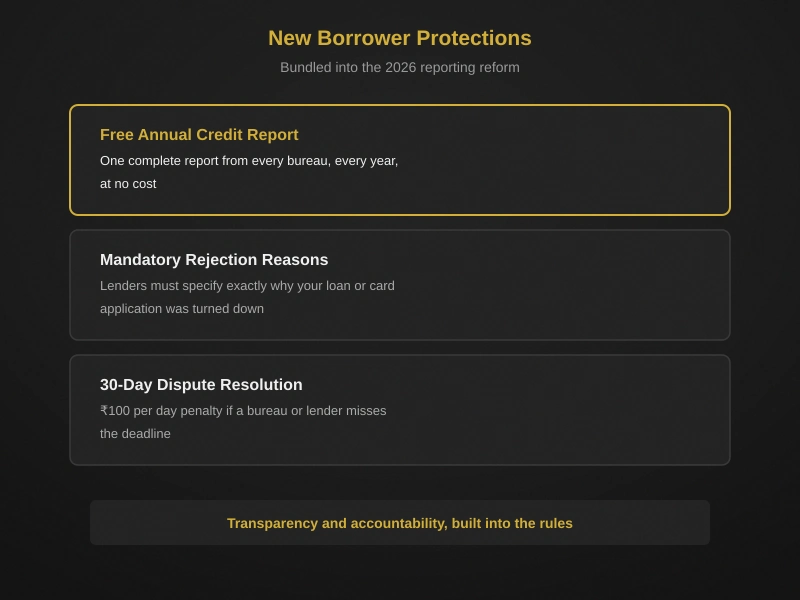
Faster reporting is the headline change, but it isn’t the only meaningful update. RBI has paired it with several borrower-facing protections that are worth knowing in detail.
A free full credit report, once a year, from every bureau. RBI has directed credit bureaus to make one complete credit report available to every borrower annually, at no cost, accessible directly through the bureau’s own website. This gives you a genuine way to check your own credit history and catch errors without paying a subscription fee just to see your own data.
Lenders must state exactly why they rejected you. Under the updated framework, if a bank or NBFC turns down your loan or credit card application, they’re required to specify the actual reason for the rejection, rather than leaving you to guess whether it was your score, your income documentation, or something else entirely. This is a meaningful shift toward transparency in a process that’s historically been something of a black box for applicants.
The Dispute Resolution Timeline: 30 Days or a Penalty
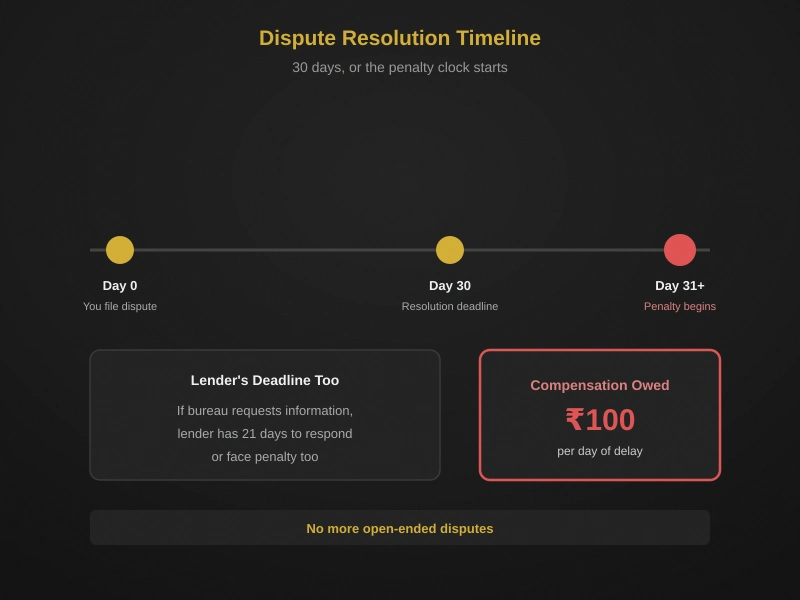
This is the part of the credit score dispute resolution RBI framework that actually has teeth. If you spot an error on your credit report, whether it’s a loan you already closed still showing as active, or a payment marked late that you actually made on time, both the credit bureau and your lender are now treated as formally accountable for resolving it.
Bureaus and lenders must resolve a disputed entry within 30 calendar days. If they don’t, they owe you ₹100 for every additional day of delay. There’s a related deadline on the lender’s side too: if a bureau requests information from a lender to help resolve a dispute, the lender has 21 days to furnish it, or a similar penalty framework kicks in. Together, these deadlines are meant to stop credit report disputes from dragging on indefinitely, which was a common and genuine borrower complaint before this update, not unlike the escalation structure covered in our UPI Payment Failed Money Debited guide, where a similar RBI-mandated timeline and compensation framework applies to failed transactions.
What You Should Actually Do Differently Now
Given how much faster your credit behavior now reflects in your report, a few habits are worth adjusting.
Check your credit report at least once a quarter, not just once a year, since errors and updates now surface faster and are worth catching early. Use the newly mandated free annual report as your baseline check, and consider a mid-year check through your bank’s app or a bureau’s paid service if you’re planning a major loan application soon.
If you spot an error, file a dispute immediately rather than waiting, since the 30-day clock (and your right to compensation if it’s missed) only starts once you’ve actually raised the issue. Keep documentation of your dispute filing date, since that’s what establishes the timeline for the penalty provision.
If you’re managing multiple credit products and want a clearer sense of how EMI timing affects your overall financial picture, it’s worth reviewing your commitments the same way you’d review what a joint account means for shared financial obligations, understanding exactly what’s reported, and when, protects you either way.
Frequently Asked Questions
What are the CIBIL score new rules 2026?
The CIBIL score new rules 2026 require that, effective July 1, 2026, banks and NBFCs must report credit data to bureaus four times a month, on the 9th, 16th, 23rd, and the last day, instead of once monthly. This is paired with a mandatory free annual credit report, required disclosure of loan rejection reasons, and a 30-day dispute resolution deadline with a ₹100/day penalty for delays.
How much faster will my credit score update now?
Positive changes like a cleared loan or paid-off credit card can reflect in your report within roughly a week to ten days, compared to waiting nearly a month under the previous reporting cycle.
What happens if a credit bureau doesn’t resolve my dispute in time?
If a disputed entry isn’t resolved within 30 calendar days, the bureau or lender responsible owes you ₹100 for every additional day of delay beyond that deadline.
Can I get my credit report for free?
Yes. RBI has mandated that credit bureaus provide one complete, full credit report to every borrower annually at no cost, accessible directly through the bureau’s website.
Do lenders have to tell me why my loan was rejected?
Yes, under the updated framework, lenders must specify the exact reason for rejecting a loan or credit card application, rather than leaving the decision unexplained.
CIBIL score ke naye rules 2026 kya hai?
CIBIL score new rules 2026 ke according, 1 July 2026 se, banks aur NBFCs ko credit bureaus ko mahine mein 4 baar report karna hoga, 9th, 16th, 23rd, aur mahine ke last din. Iske saath free annual credit report, loan rejection ka reason batana, aur 30-din dispute resolution deadline bhi mandatory hai.
Mera credit score kitni jaldi update hoga ab?
Cleared loan ya paid-off credit card jaisi positive changes ab roughly ek hafte se das din mein reflect ho sakti hai, jabki pehle poora mahina lagta tha.
Agar bureau meri dispute time pe resolve na kare toh kya hoga?
Agar disputed entry 30 calendar days ke andar resolve nahi hoti, toh bureau ya lender har extra din ke liye aapko ₹100 dene ke liye obligated hai.
Kya mujhe free mein credit report mil sakta hai?
Haan, RBI ne mandate kiya hai ki har bureau saal mein ek baar poora credit report free mein de, jo bureau ki apni website se access ho sakta hai.
Managing Your Overall Financial Health?
If you’re working on your credit profile alongside other financial goals, our PPF vs Sukanya Samriddhi Yojana guide and Best Mutual Funds to Invest in 2026 picks are useful next reads for building the savings side of your financial picture alongside a healthy credit score. And if you’re keeping track of other RBI-driven changes to everyday banking, our RBI UPI 2FA Rules 2026 guide covers the security side of that same regulatory push.
Disclaimer: This guide is for informational and educational purposes only and does not constitute financial or legal advice. RBI’s credit reporting guidelines and their implementation timelines can be updated. Always verify current requirements through your bank, the credit bureau’s official website, or RBI’s official notifications.
About the Author
Ashish Kumar is a finance and business content writer with over 5 years of experience specializing in personal finance, banking, insurance, taxation, investments, fintech, and business trends. Through BusinessBuilts, he publishes well-researched, accurate, and easy-to-understand content based on credible sources and the latest industry developments to help readers make informed financial decisions.
