


⚡ Quick Answer
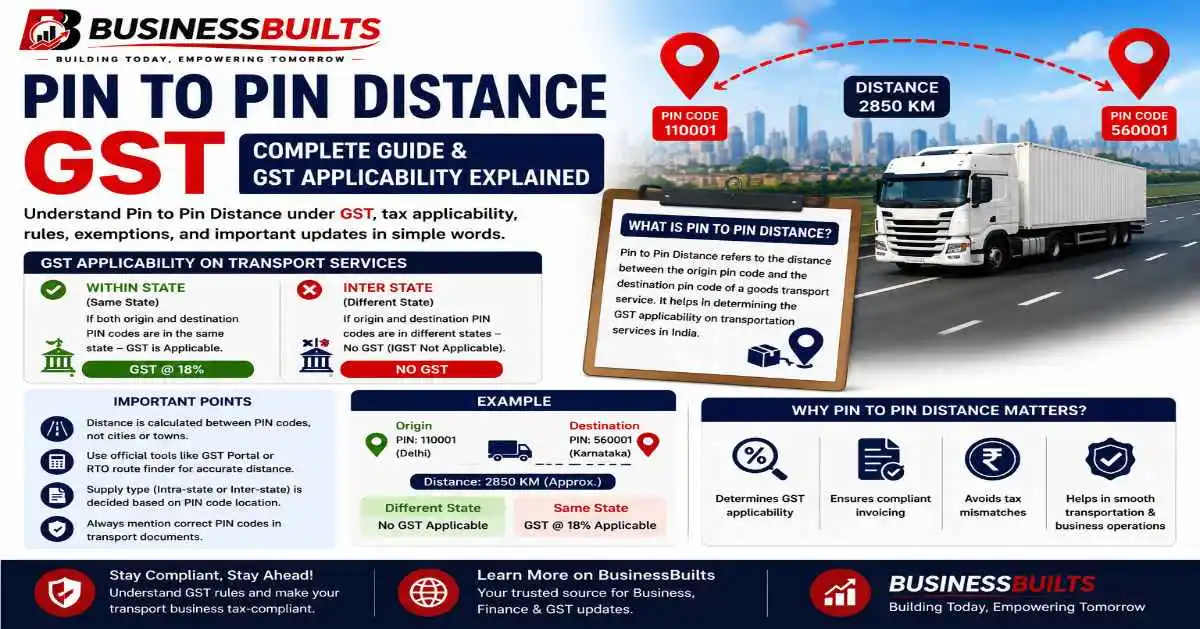
Pin to pin distance is the approximate road distance (in km) between your dispatch and delivery PIN codes, calculated automatically by the GST E-Way Bill portal. It decides how many days your E-Way Bill stays valid — you get 1 day of validity for every 200 km (or part of it) for regular cargo, and 1 day per 20 km for Over-Dimensional Cargo (ODC). Check it free at ewaybillgst.gov.in under Search → Pin to Pin Distance, no login required.
Last updated: August 2026 | Written by Ashish Kumar, Founder at BusinessBuilts
You are sitting there generating an E-Way Bill, and the portal asks for pin to pin distance. Maybe you have never filled this field before. Maybe you filled it once, got it wrong, and had a transporter stopped at a checkpoint over it. Either way, this guide from BusinessBuilts walks you through exactly what this number means, where it comes from, and how to get it right every time.
What Pin to Pin Distance Actually Means
Pin to pin distance is the approximate road distance between two Indian PIN codes, the one where your goods are dispatched from and the one where they are delivered to. You enter both PIN codes on the GST E-Way Bill portal, and the system calculates a distance in kilometers.
This entire requirement traces back to Rule 138 of the CGST Rules, which mandates an E-Way Bill for any movement of goods valued above ₹50,000. The distance field exists specifically to make that rule enforceable, without it, there’d be no objective way to check whether a shipment is still within its legal transit window.
Here is the part people miss: this is not the straight-line distance you would get from a map ruler. It is closer to an actual road distance, though it is still a system estimate, not a live GPS reading from your truck. This is also commonly searched as pincode to pincode distance or pin code distance, since both terms point to the same thing.
Say you are shipping textiles from a warehouse in Surat (PIN 395001) to a buyer in Ahmedabad (PIN 380001). You do not need to calculate this yourself using a map or ask your driver to guess. You enter both PIN codes into the GST E-Way Bill distance calculator, and it returns a number, somewhere around 270 km for this particular route. That number becomes part of your E-Way Bill.
One thing worth understanding upfront: an E-Way Bill has two parts. Part A carries your GSTIN, invoice number, and HSN codes. Part B carries the vehicle number and the distance we’re talking about in this guide. The validity period doesn’t start from your invoice date or from when you fill out Part A, it starts from the moment Part B, the distance and vehicle details, gets generated. If you generate Part A early but delay entering the vehicle number and distance, your validity clock hasn’t started yet, it starts only when Part B is complete.
Who This Guide Is For
This isn’t just for accountants filling out forms. Pin to pin distance touches a wider set of people than most guides admit:
Business owners and traders who ship goods regularly need this number correct every single time, since even one wrong PIN code can stall a shipment.
CAs and tax consultants handling GST compliance for multiple clients use this to double-check distances before filing, catching errors before they turn into notices.
Logistics and dispatch managers rely on this figure for route planning, delivery timelines, and comparing transporter quotes.
Transporters and fleet operators generating e-way bills on behalf of clients carry the compliance risk if the PIN code data they’re given is wrong.
E-commerce sellers managing their own logistics need this for both compliance and serviceability mapping.
Why This Number Actually Matters
GST · E-Way Bill
Pin to Pin Distance Calculator
Enter both PIN codes to get the actual road distance, estimated travel time, and E-Way Bill validity in one step.
Distance is estimated from open map routing data and may vary slightly from the official GST portal figure. Always cross-check on ewaybillgst.gov.in before generating your E-Way Bill, especially for high-value shipments.
The pin to pin distance is not just a formality. It directly sets how long your E-Way Bill stays valid.
| Distance | Regular Cargo | ODC Cargo | Example Route |
|---|---|---|---|
| Up to 200 km | 1 day | 10 days | Delhi to Jaipur (~270 km) |
| 200 to 400 km | 2 days | 20 days | Ahmedabad to Mumbai (~525 km) |
| 400 to 600 km | 3 days | 30 days | Bangalore to Hyderabad (~570 km) |
| 600 to 800 km | 4 days | 40 days | Hyderabad to Chennai (~625 km) |
| 800 to 1000 km | 5 days | 50 days | Kolkata to Lucknow (~985 km) |
| 1000 to 1200 km | 6 days | 60 days | Surat to Delhi (~1,175 km) |
| 1200 to 1400 km | 7 days | 70 days | Mumbai to Kolkata (~1,400 km) |
| Every extra 200 km (or part) | 1 more day | 10 more days | Applies beyond 1,400 km |
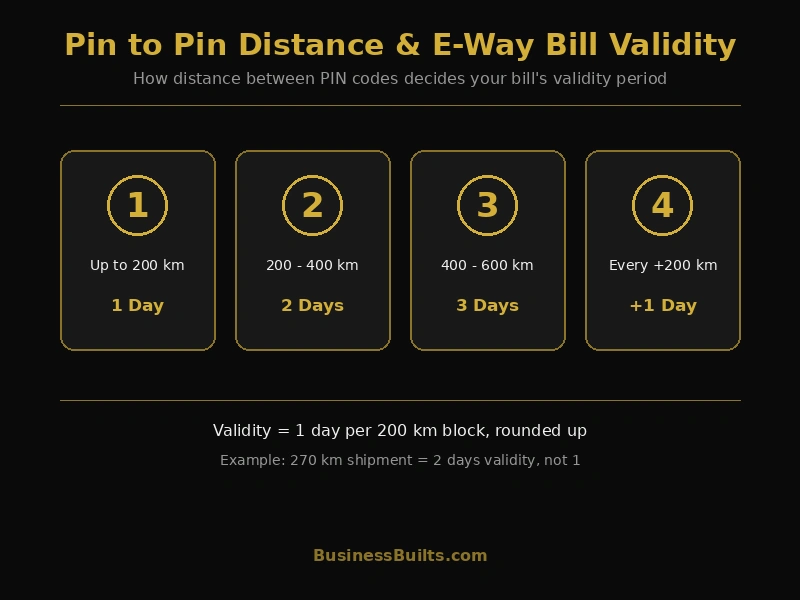
So if your Surat to Ahmedabad shipment shows 270 km, you get 2 days of validity, not 1. If your goods do not reach the destination within that window, the bill expires. An expired E-Way Bill sitting with your driver at a checkpoint is not a paperwork issue anyone wants to deal with, it can mean the vehicle gets detained until a fresh bill is generated, and depending on the situation, penalties under Section 129 of the GST Act can apply. That penalty typically works out to the applicable tax amount or ₹10,000, whichever is higher, which is a meaningful hit for what often starts as a simple data entry mistake.
When an expired or mismatched e-way bill gets flagged at a checkpoint, officers acting under Section 129 can take several steps:
- Detain the vehicle and the goods on the spot
- Demand payment of the applicable tax before release
- Levy a penalty equal to the tax amount, or ₹10,000, whichever is higher
- Issue a notice for physical inspection of the entire consignment
None of this requires proof of intent to evade tax — a genuine data entry error can trigger the same process as a deliberate understatement.
One important exception: this 200 km rule applies to regular cargo only. If you’re transporting Over-Dimensional Cargo (ODC), think oversized machinery, construction equipment, or anything that can’t be dismantled to fit standard truck dimensions, the validity window is far tighter. For ODC shipments, you only get 1 day of validity for every 20 km, not every 200 km. A 300 km ODC shipment gets roughly 15 days of validity calculated this way versus the 2 days a regular cargo shipment would get. If your business regularly moves oversized equipment, this distinction matters far more than the standard rule does.
There’s one more variation worth knowing: if any part of your consignment’s journey involves transport by ship, the portal adds 2 extra days of validity on top of whatever the standard road-distance calculation gives you. This accounts for the additional time water transport typically requires compared to road-only routes.
This is why understating the pin to pin distance is risky. If you enter 150 km for a route that is actually 350 km, your bill gets 1 day of validity when the shipment genuinely needs 2. The goods will not make it in time, at least not on paper, even if the truck is moving exactly as planned.
How to Check Pin to Pin Distance on the GST Portal
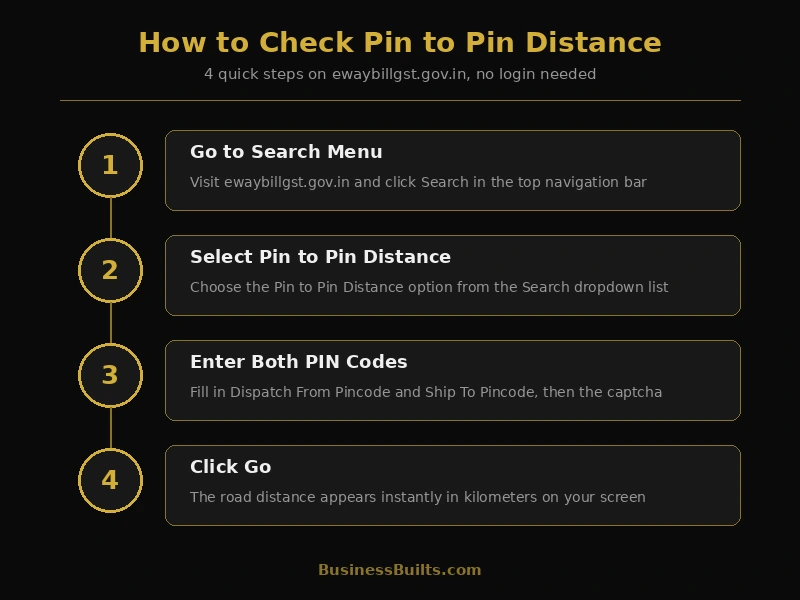
There are two ways to check pin to pin distance. Pick whichever fits where you are in the process.
If you just want to check the distance before generating anything:
Go to ewaybillgst.gov.in. Click Search in the top menu, then select Pin to Pin Distance. Enter the Dispatch From Pincode and the Ship To Pincode, complete the captcha, and click Go. You get the road distance instantly, no GSTIN login required. This is the fastest option if you are planning ahead or just want to sanity check a number before committing to it.
If you are already generating the actual E-Way Bill:
Log in to ewaybillgst.gov.in with your GSTIN credentials. From the left-side menu, go to Search, then Pin to Pin Distance. Enter both PIN codes and click Get Distance. Same result, just inside your logged-in session so you can carry the number straight into your bill.
Either method pulls from the same underlying data, so it does not matter which one you use. Use the public search when you want a quick check, use the logged-in version when you are mid-workflow.
When the Portal’s Distance Does Not Match Reality
This trips up more businesses than you would expect. The portal gives you a system-calculated approximation of the pin to pin distance. It does not always account for a specific route your transporter actually takes, especially on routes with detours, hill roads, or stretches where the direct highway is not usable for heavy vehicles.
Since a recent GSTN update, the E-Way Bill portal itself suggests a distance based on your entered PIN codes when you generate the bill. If the distance you type in differs significantly from this system-suggested figure, the portal may flag it for review. This makes it even more important to check the actual PIN-to-PIN distance before you start filling out the bill, rather than estimating it on the fly.
If your actual dispatch route runs meaningfully longer than what the portal shows, you are allowed to enter the higher, real distance manually when generating the bill. Nobody is forcing you to use the system figure if you know it is wrong for your specific shipment.
There’s a limit to how much higher you can go, though. The distance you manually enter should not exceed the portal’s calculated distance, officially called the NIC distance (from the National Informatics Centre, which maintains this data), by more than 10%. If your actual route diverges from the NIC distance by more than that, the safer move is to raise a grievance through the E-Way Bill helpdesk at 1800-103-5200 rather than simply overriding the number yourself, especially for high-value shipments where a mismatch could draw scrutiny.
A logistics company we came across as an example: they regularly ship goods between two cities where the straight portal distance shows around 180 km, but their actual trucking route, due to a mandatory weighbridge stop and a stretch of road closed to heavy vehicles, runs closer to 230 km. They enter 230 km on the bill, not 180, and they keep a route document on file in case it is ever questioned. That is the right instinct. Match the number to reality, and keep evidence if the two diverge by a lot.
Is There a Minimum Distance for Generating an E-Way Bill
No. There is no minimum pin to pin distance rule. If you are moving goods worth more than 50,000 rupees, you need an E-Way Bill whether the distance is 3 km across town or 1,300 km across the country. Distance only comes into play for calculating validity, not for deciding whether you need the bill in the first place.
What Happens If You Get the Distance Wrong
If the vehicle has not moved yet: You can cancel the E-Way Bill within 24 hours of generating it and reissue a fresh one with the correct pin to pin distance. This is the cleanest fix, so if you catch the error early, use it.
If the vehicle is already on the road: You cannot directly edit the distance field. What you can do is extend the validity period through the portal before the bill expires, provided you have a valid reason, things like a breakdown, natural calamity, or law and order situation are typically accepted grounds. Trying to fix a distance error after the fact is far more of a hassle than catching it before you submit, which is really the whole point of double-checking the PIN codes upfront.
Mistakes That Keep Coming Up
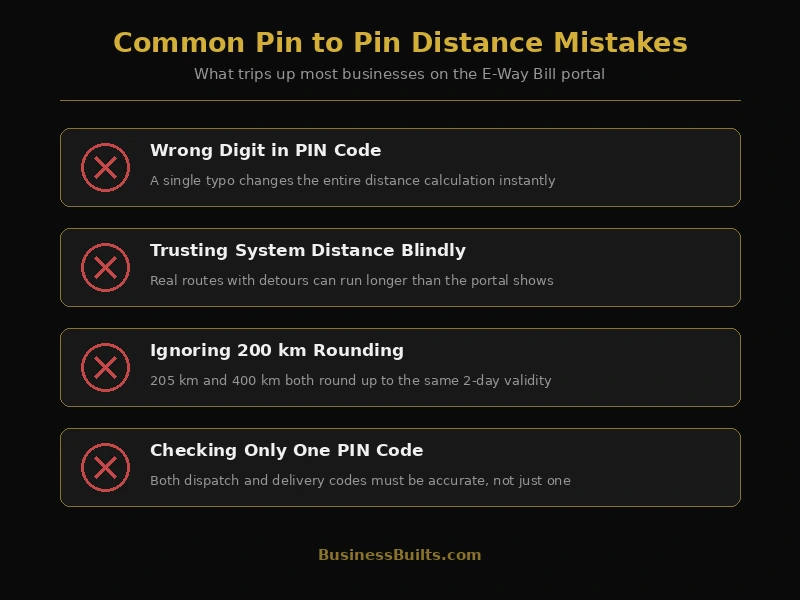
A single wrong digit in the PIN code. This sounds small, but it changes the entire pin to pin distance calculation, sometimes without anyone noticing until the bill is already generated. Nearby areas can have PIN codes that differ by just one digit, so a rushed entry is an easy way to end up with a distance that makes no sense for the actual shipment.
Treating the system distance as gospel for every route. As covered above, it is an approximation. For routes with real-world detours or restrictions, verify it against how your transporter actually drives, not just what the portal says.
Not accounting for how the 200 km blocks round up. A distance of 205 km gets the same validity as a distance of 400 km, both round up to 2 days. Understanding this rounding helps you plan dispatch timing more realistically instead of assuming validity scales in small increments.
Only checking one PIN code and assuming the other is fine. Both the dispatch and delivery PIN codes need to be accurate. An error on either end throws off the result.
Beyond the E-Way Bill: Other Uses for Pin to Pin Distance
Freight cost calculation. Transporters charging per kilometre need this number to quote accurately. If a transporter charges ₹12 per km for a full truckload and the distance is 840 km, that’s roughly ₹10,080 before additional charges.
Delivery radius planning. E-commerce sellers and local retailers use PIN-to-PIN distance to decide whether a location falls within their serviceable delivery zone.
Transit time estimation. The same distance data helps plan realistic delivery windows and warehouse placement for businesses serving multiple states.
Insurance and claims. Some cargo insurance policies factor in transit distance when assessing risk, so accurate distance records can support smoother claim processing.
Which Businesses Feel This the Most
Manufacturers dealing in high-value goods with multiple daily dispatches carry the biggest exposure — a wrong entry on a large consignment can mean a six-figure penalty.
Traders and wholesalers shipping to multiple destinations face higher error risk simply because of volume.
MSMEs running lean teams, where the same person handles billing, dispatch, and compliance, are especially prone to rushed PIN code entry.
Transporters generating e-way bills on a client’s behalf inherit the compliance risk if client-provided PIN data is wrong.
Frequently Asked Questions
What is pin to pin distance in a GST E-Way Bill?
It is the approximate road distance between your dispatch PIN code and delivery PIN code, calculated by the E-Way Bill portal. This number sets how many days your bill stays valid.
Can I check pin to pin distance without logging into the portal?
Yes. Go to ewaybillgst.gov.in, click Search, select Pin to Pin Distance, enter both PIN codes and the captcha, then click Go. No GSTIN login needed for this check.
What happens if I enter the wrong distance on my E-Way Bill?
If the distance is too low, your bill may expire before the goods arrive, risking detention and penalties. If the vehicle has not moved yet, you can cancel within 24 hours and reissue with the correct number.
Is there a minimum distance required to generate an E-Way Bill?
No. Any shipment of goods worth over 50,000 rupees needs an E-Way Bill, regardless of how short or long the distance is.
How exactly does distance affect how long my E-Way Bill stays valid?
Every 200 km, or any part of that block, adds one day of validity. A shipment of 210 km and a shipment of 400 km both get 2 days, since both fall within that second 200 km block.
Pin to pin distance GST mein kya hota hai?
Ye dispatch aur delivery PIN code ke beech ka approximate road distance hai, jo E-Way Bill portal khud calculate karta hai. Ye number decide karta hai ki bill kitne din valid rahega.
Bina login kiye pin to pin distance kaise check karein?
ewaybillgst.gov.in par jaake Search mein Pin to Pin Distance select karo, dono PIN codes aur captcha bharo, phir Go dabao. Login ki zaroorat nahi hai.
Agar distance galat bhar diya to kya hoga?
Kam distance daalne se bill goods pahunchne se pehle expire ho sakta hai. Agar vehicle abhi move nahi hua hai, to 24 ghante ke andar cancel karke sahi number ke saath dobara generate kar sakte ho.
E-Way Bill ke liye minimum distance zaroori hai kya?
Nahi. Jab bhi goods ka value 50,000 rupaye se zyada hai, E-Way Bill chahiye, chahe distance kitna bhi ho.
Related Posts
Quick Glossary: Terms You’ll See Used Interchangeably
| Term | What It Means |
|---|---|
| Pin to Pin Distance | Road distance between source and destination PIN codes |
| Pincode Distance / Pincode to Pincode Distance | Same concept, used interchangeably |
| GST Distance Calculator | The portal tool used to compute this distance |
| E-Way Bill Validity | Time period for which a generated e-way bill remains valid |
| Road Distance vs Aerial Distance | Road distance follows actual routes; aerial distance is shorter and not accepted for GST |
Before You Go
The pin to pin distance field looks small on the screen, but it is one of the few E-Way Bill entries that can genuinely stall a shipment if it is wrong. Check it on the portal before you generate the bill, compare it against your actual route if something feels off, and keep the 200 km validity rule in mind so you are not caught off guard mid-transit.
Still unsure about your specific route or facing a distance mismatch issue? Drop your question in the comments below, and we will help you work through it. If this guide saved you a headache, share it with someone on your team who handles E-Way Bill generation too.
Brought to you by BusinessBuilts, helping Indian businesses navigate GST compliance with clear, practical guides.
Disclaimer
This guide is based on publicly available information from the GST E-Way Bill portal and is meant for general informational purposes. Rules and portal features can change. Check ewaybillgst.gov.in directly or talk to a tax professional before relying on this for compliance decisions.
About the Author
Written by Ashish Kumar, Founder at BusinessBuilts
Ashish Kumar is a finance and business content writer with over 5 years of experience specializing in personal finance, banking, insurance, taxation, investments, fintech, and business trends. Through BusinessBuilts, he publishes well-researched, accurate, and easy-to-understand content based on credible sources and the latest industry developments to help readers make informed financial decisions.
