


Last updated: July 2026 | Written by Ashish Kumar, Founder at BusinessBuilts
You opened your admit card, checked your exam date and time, and then your eyes landed on a line you’ve probably never seen before: “Venue: ION Digital Zone.” No landmark you recognize, no college name, just this unfamiliar phrase and an address in a part of town you may have never visited. At BusinessBuilts, we get this question from exam aspirants often enough that it’s worth a complete, straightforward answer.
If that’s how you ended up here, take a breath. It’s not some secretive facility or a scam center. An ION Digital Zone exam centre is one of the most common exam venues in India, and by the end of this guide you’ll know exactly what to expect, what to carry, and how to make sure you show up at the right place at the right time.
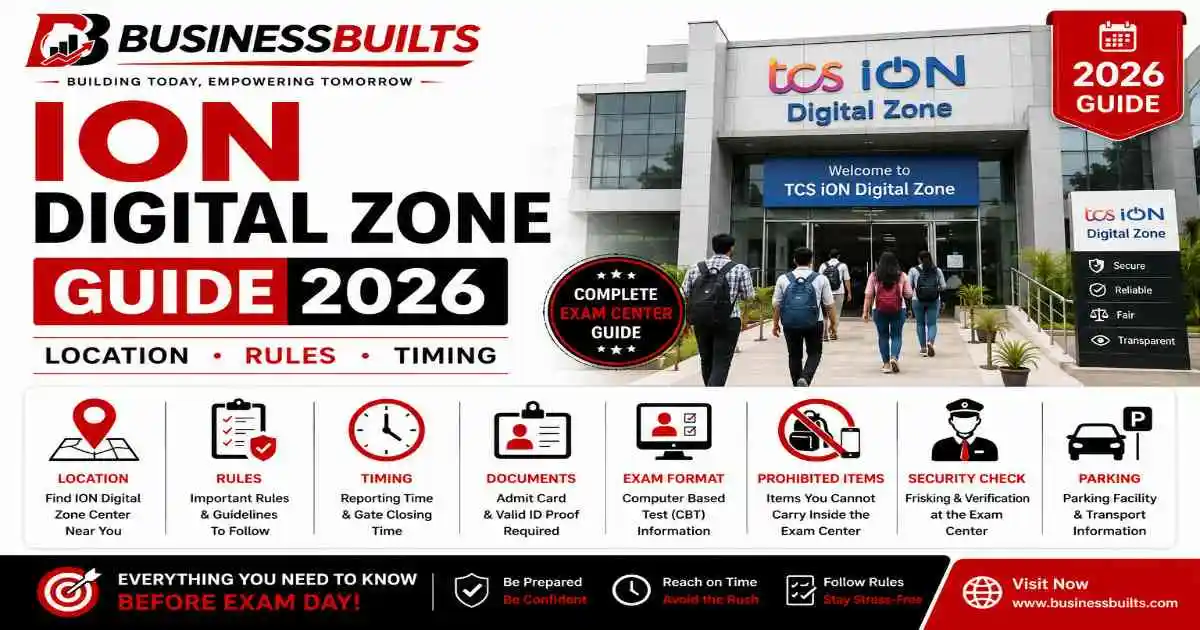
What Is a TCS iON Digital Zone?
TCS iON Digital Zone is a business unit of Tata Consultancy Services. It’s not the same wing that builds software for banks and airlines. This part of TCS focuses specifically on running large-scale digital assessments and recruitment processes for government departments, banks, universities, and private companies.
Think of iON as the invisible machinery behind a huge chunk of India’s competitive exams. When a bank needs to test two lakh candidates for a clerk position, or a state government needs to run a recruitment exam across forty cities on the same day, someone has to build the systems, secure the question papers, manage the centers, and stop cheating at scale. That’s the job TCS iON does.
An “iON Digital Zone” is simply the physical center where this happens. TCS calls its approach “phygital,” which just means physical space plus digital systems working together. The building might look like an ordinary office or a training institute from the outside. Inside, it’s wired for computer-based testing with the kind of security a paper exam center never had.
You don’t apply to TCS iON directly and you don’t pay them anything. The exam conducting body (say, IBPS or a state SSC board) hires TCS iON to run the test, and your admit card simply tells you which of their centers you’ve been assigned to.
Why Is It Called a “Digital Zone”?
The name isn’t just branding. It describes exactly what changes for you as a candidate compared to a traditional exam hall.
Here’s what’s actually happening behind the scenes:
- Encrypted question papers are delivered to the center’s system shortly before your shift, not printed and transported days in advance where they could leak.
- Biometric attendance (usually fingerprint or facial scan) replaces the old sign-in register, which cuts down on impersonation.
- CCTV coverage runs through every hall, and in many centers this feeds into an AI-based command center that TCS iON monitors in real time across the country.
- Standardized software means your test screen, timer, and submission process look the same whether you’re sitting in Patna or Coimbatore.
For you, this translates into something practical: the exam-day experience is far more predictable than it used to be with paper exams. Once you know how one iON Digital Zone works, you basically know how they all work, no matter which city you’re assigned to.
Which Exams Are Conducted at iON Digital Zones?
If you’re preparing for a competitive exam in India, there’s a good chance you’ll sit for at least one test at an iON Digital Zone exam centre during your prep journey. The centers are used across a wide range of exams, including:
- Banking exams like IBPS PO, IBPS Clerk, SBI PO, SBI Clerk, and RBI recruitment tests
- SSC exams including CGL, CHSL, and MTS
- Railway recruitment through RRB, covering NTPC and Group D
- Insurance sector exams such as LIC AAO and NICL
- University entrance and admission tests for several state and private universities
- Corporate hiring assessments, since some private companies also use TCS iON’s testing infrastructure for their own recruitment drives
One thing worth knowing: not every center runs every exam. A particular iON Digital Zone near you might be set up for banking exams this month and switch to a state recruitment test the next. That’s exactly why checking your own admit card carefully matters more than searching for general information about “the iON Digital Zone” as if there’s only one.
How to Find and Verify Your Exact iON Digital Zone Center

Here’s something a lot of directory websites get wrong, and it can cost you an exam if you’re not careful: TCS iON runs hundreds of Digital Zones across India, and they all share the same brand name. There isn’t one “iON Digital Zone.” There’s a Gurugram one, a Jodhpur one, a Bhubaneswar one, a Guntur one, an ION Digital Zone Sector 62 Noida location that sees heavy footfall from Delhi NCR candidates, and dozens more.
So the exact ION Digital Zone location you find on a random Google search may not be your center at all.
To confirm your actual venue, follow this order of trust:
- Start with your admit card. The full address, along with a reporting time, is printed there. This is your primary source, not a website.
- Cross-check on the exam conducting body’s official portal. Most banking, SSC, and railway recruitment sites let you download your admit card again or view venue details through your login. If there’s a mismatch, trust the official portal over anything else.
- Avoid relying on general directory listings for exam-day navigation. Sites that aggregate business addresses can carry outdated information, especially if a center has shifted locations, which does happen between exam cycles.
- Call the center directly using the number on your admit card if you have any doubt, ideally a day or two before your exam, not the morning of.
- Use Google Maps with the exact address from your admit card, not just a generic search for “iON Digital Zone” near you, since a nearby result might belong to a completely different city block or even a different exam altogether.
ION Digital Zone kaise pahunche? This is one of the most common last-minute searches the night before an exam, and the honest answer depends entirely on which center you’ve been assigned. Once you have the exact address from your admit card, check three things: the nearest metro or railway station, whether local buses run that route, and whether a cab or auto is realistically available at your reporting time (early morning shifts sometimes mean thinner cab availability). Centers like ION Digital Zone Sector 62 Noida are well connected by metro, but a center in a smaller town might mean planning an auto or shared cab in advance. Don’t leave this research for exam morning.
A quick real-world example: a candidate with an SBI Clerk exam in Hyderabad searched “iON Digital Zone Hyderabad” and found a center in Gachibowli. Her actual admit card, though, listed a center in Kukatpally. Same brand name, different physical location, completely different part of the city. She caught it two days early because she compared the address on her admit card word for word with what she’d found online. That habit is worth building for any exam you take.
ION Digital Zone Location Map
Since TCS iON runs hundreds of Digital Zones across India, there is no single pin you can drop for “the” iON Digital Zone. What you can do is use the map below as a starting point to visually locate iON Digital Zone centers near you, and then confirm the exact one against your own admit card address before you travel.
A quick way to use this map properly: search the exact address from your admit card inside Google Maps directly, rather than just searching “iON Digital Zone near me.” As covered above, the same brand name covers dozens of unrelated locations, so a nearby pin on this map is not automatically your center.
If you already know your assigned city, you can also check our center-specific guides for exact addresses and directions, including iON Digital Zone iDZ Tupudana, Ranchi, iON Digital Zone Old Alwal, and other city guides on BusinessBuilts.
What to Expect on Exam Day: ION Digital Zone Exam Day Guidelines

Knowing the process in advance takes a lot of the anxiety out of exam day. Here’s what typically happens, though you should always confirm exact timings on your own admit card since they vary by conducting body.
ION Digital Zone reporting time. Most exams ask you to report 60 to 90 minutes before your shift starts. This isn’t padding. Biometric verification and security checks take time, and gates usually close well before the test begins with no exceptions made for late arrivals.
Documents to carry. Your admit card (printed, not just on your phone), a valid original photo ID like Aadhaar, PAN, voter ID, or passport, and passport-size photographs if your admit card specifies them. Photocopies of your ID are usually not accepted on their own.
Security check. Expect frisking at the entrance. Electronic devices, smartwatches, wallets with metal parts, and sometimes even certain types of jewelry may not be allowed inside. These ION Digital Zone rules are set by the exam conducting body, not TCS iON itself, so always check your specific admit card’s list of prohibited items since this varies by exam.
Biometric and ID verification. You’ll go through fingerprint or facial recognition scanning along with a manual ID check against your admit card photo. If you want a full walkthrough of what to pack and prepare, our exam-day checklist covers it step by step.
Seating and system login. Once you’re seated at your assigned system, you’ll usually get a short demo or mock screen before the actual test begins, so you can get comfortable with the interface, mouse, and timer before it counts.
During the exam. Invigilators walk the hall, and CCTV monitors everything. If you face a technical issue like a screen freeze or a login error, raise your hand and inform the invigilator immediately rather than waiting it out. These centers are built to handle glitches, and reporting one quickly protects your attempt.
Facilities You Can Expect at an iON Digital Zone
Most centers follow a similar standard, though the exact scale depends on the size of the venue. Typical facilities include:
- Air-conditioned halls with dedicated computer systems for each candidate
- Biometric verification equipment and CCTV coverage throughout
- Parking space, though availability can be tight during peak exam days
- Drinking water and basic seating in waiting areas
- Seating capacity that ranges from a couple hundred to five hundred or more candidates per shift, depending on the center
Don’t expect food courts or extensive waiting lounges. These are functional testing centers, not exam campuses, so plan to eat before you arrive and carry a water bottle if you tend to get thirsty during long waits.
Common Problems Candidates Face (and How to Handle Them)
A lot of exam-day stress comes from a handful of predictable problems. Here’s how to handle the ones that come up most often.
The address on a website doesn’t match what you find on Maps. Trust your admit card and the official exam portal over any third-party site. If there’s still confusion, call the center using the number printed on your admit card.
Your center got reassigned close to the exam date. This does happen occasionally, especially for high-volume exams. Keep checking your login on the conducting body’s website in the week before your exam, since updated admit cards are usually issued if a venue changes.
Biometric mismatch at the gate. If your fingerprint doesn’t scan cleanly (common if your hands are dry or calloused from manual work), staff at the center are trained to handle this through alternate verification like your photo ID and manual checks. Don’t panic, just cooperate with the process.
Running late due to traffic. Since gates typically close well before the shift starts, build in real buffer time, especially if you’re traveling to an unfamiliar part of a city you don’t usually visit. Arriving an hour early for a 60-minute reporting window is a reasonable habit, not overkill.
Confusion over dress code and prohibited items. When in doubt, dress simply, avoid heavy jewelry or metal accessories, and leave your smartwatch, calculator, or any unauthorized electronics at home rather than risk a delay at security.
Frequently Asked Questions
Is TCS iON Digital Zone a government or private center?
It’s a private facility run by TCS iON, a business unit of Tata Consultancy Services. It gets used by both government bodies and private organizations to conduct exams, but the center itself is privately operated.
Can I choose my iON Digital Zone center?
Generally, no. The conducting body assigns your center based on your exam application, your city preference (if the exam allows one), and seat availability. You’ll find your assigned venue on your admit card.
What if my iON Digital Zone address doesn’t match what I find on Google?
Always trust your admit card and the official exam portal first. Third-party sites can carry outdated addresses, especially if a center has relocated.
Is the iON Digital Zone the same for every exam I take?
Not necessarily. Even if you take multiple exams in the same city, you could be assigned to different iON Digital Zone locations depending on the exam, the conducting body, and seat capacity at the time. Center lists are also updated periodically, so a location you sat at in a previous year may not be the same one assigned to you in 2026.
What happens if I miss my slot?
Most exams don’t offer a rescheduled attempt for a missed slot unless the conducting body announces one for technical or administrative reasons. Check the specific exam’s rules on their official website, since policies vary between banking, SSC, and railway recruitment bodies.
ION Digital Zone kya hota hai?
ION Digital Zone TCS iON ka ek exam center hai jahan computer-based competitive exams conduct kiye jaate hain. Ye TCS ki ek business unit hai jo banks, government departments, aur universities ke liye large-scale online tests manage karti hai. Agar aapke admit card mein ye naam likha hai, to iska matlab bas itna hai ki aapka exam venue ek TCS iON center hai.
ION Digital Zone mein exam dene kya kya le jaana chahiye?
Apna admit card (printout), ek valid original photo ID (Aadhaar, PAN, voter ID, ya passport), aur agar admit card mein mention ho to passport-size photo. Electronics, smartwatch, ya heavy jewelry ghar par hi chhod dein.
ION Digital Zone time se pehle kitni der pahunchna chahiye?
Zyadatar exams 60 se 90 minute pehle reporting maangte hain. Gate close hone ke baad entry nahi milti, chahe aap kitna bhi close kyun na ho, isliye extra buffer time rakhna hi sahi rahega.
Agar mera ION Digital Zone center wrong address pe dikh raha hai to kya karu?
Hamesha apne admit card aur exam conducting body ki official website ko trust karein, kisi bhi third-party site ya Google search result ko nahi. Confusion ho to center ko admit card wale number par directly call kar lein.
Before You Go
Walking into an unfamiliar exam venue is stressful enough without wondering what iON Digital Zone even means. Now that you know it is simply TCS’s testing infrastructure and not a mystery location, the only thing left to double-check is your own admit card details and reporting time.
Bookmark this page and come back to it the night before your exam, it is a faster refresher than digging through your admit card PDF again. Share it with a friend or sibling who has an upcoming exam too, since most first-time candidates run into the exact same confusion you did.
For center-specific guides with exact addresses and directions, check our iON Digital Zone iDZ Tupudana, Ranchi and other city guides on BusinessBuilts. And if you are not sure which exam to prepare for next, browse the full exam guide library on BusinessBuilts for more centre-specific and preparation resources.
Disclaimer
This guide is based on general information about how TCS iON Digital Zone centers operate and is intended to help candidates understand the process, not to replace official instructions. Reporting times, permitted items, security procedures, and center addresses are set by the individual exam conducting body and can vary or change between exam cycles.
Always verify your exact center address, reporting time, and entry rules against your own admit card and the official website of the exam conducting body before you travel. BusinessBuilts is not affiliated with TCS iON or any exam conducting body, and this guide should not be treated as an official source for exam-day instructions.
Related Reads on BusinessBuilts
- iON Digital Zone Old Alwal: Exact Location, Directions & Exam Day Guide (2026)
- TCS iON Digital Zone Explained: What It Is, Is It Legit, and How It’s Different From TCS
About the Author
Written by Ashish Kumar, Founder at BusinessBuilts
Ashish Kumar is the founder of BusinessBuilts, where he writes fact-checked guides on business, finance, education, and technology topics for everyday readers. He double-checks facts, figures, and claims before publishing, and updates older articles whenever new, verifiable information becomes available.
Have feedback on this guide or noticed something that’s changed? Reach out to the BusinessBuilts team.
