


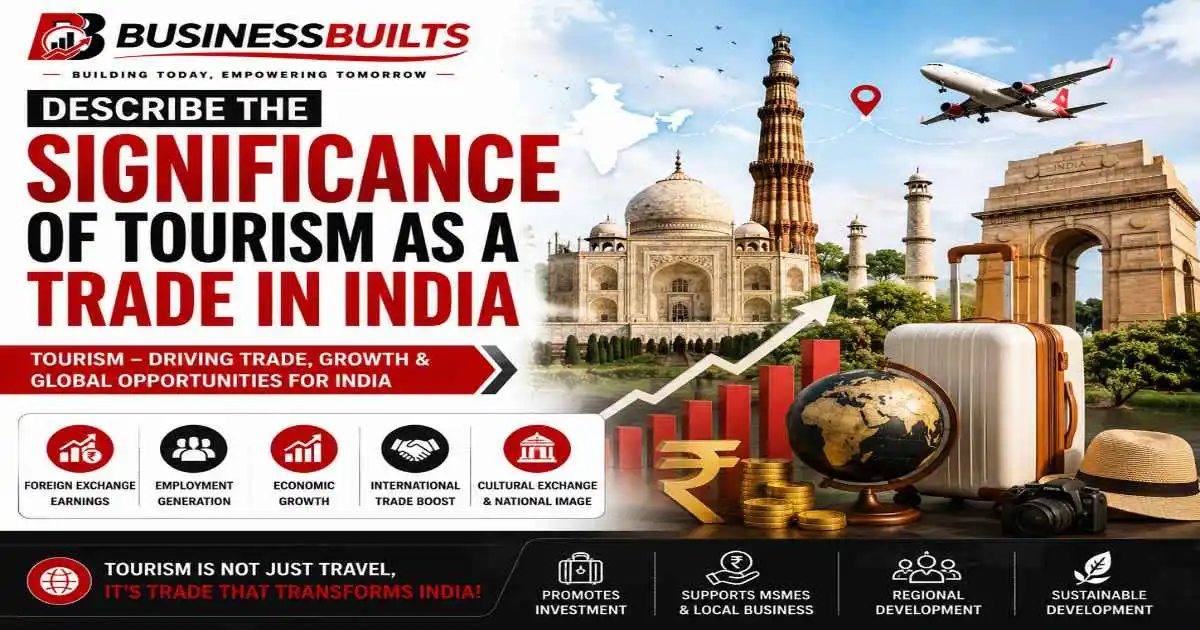
If you have ever wondered why your Geography or Economics textbook keeps bringing up tourism whenever it talks about trade, here is the short version: tourism is not just about sightseeing. It is one of India’s biggest sources of income, jobs, and global goodwill, and it works almost exactly like an export business, except instead of sending goods abroad, India brings the buyers home.
This guide is here to describe the significance of tourism as a trade in India, and to break down what makes it matter to the economy and how it plays out in real life. If you’re a Class 10 student trying to write a solid exam answer, a competitive exam aspirant who needs the bigger picture, or a parent helping your child with homework, this covers it all. BusinessBuilts has put this together with the latest available data so you get an answer that actually reflects where things stand today, not numbers from a decade ago.
What Do We Mean by “Tourism as a Trade”?
Trade usually makes people think of goods crossing borders. Tourism flips that idea. Instead of a product leaving the country, a customer (the tourist) enters the country and spends money here on hotels, food, transport, shopping, and experiences. That spending brings in foreign currency the same way an export sale would.
This is exactly why economists call tourism an “invisible export.” Nothing physical is shipped out, but the money still comes in. A French traveler paying for a houseboat stay in Kerala or a Japanese tourist buying a Pashmina shawl in Srinagar is, in economic terms, doing the same job as a container of textiles being exported to Europe.
Quick answer: Tourism is significant as a trade in India because it earns foreign exchange, generates large-scale employment, contributes meaningfully to GDP, supports cultural preservation, and drives infrastructure growth in regions that would otherwise see little investment.
Quick Exam Answer: Describe the Significance of Tourism as a Trade in India
If you need a fast, exam-ready answer (perfect for a Class 10, 3 to 5 mark question), here it is:
- Foreign exchange earnings: Tourism brought in around ₹2.74 lakh crore in foreign exchange in 2025, making it a major contributor to India’s forex reserves.
- Employment generation: The sector supports close to 84.63 million jobs, both direct and indirect, accounting for roughly 13.34% of total employment in the country.
- GDP contribution: Tourism contributes about 5 to 7% to India’s GDP, with 2025 figures placing its contribution at approximately $231.6 billion, making India the world’s eighth largest tourism economy, according to WTTC’s India Travel & Tourism Economic Impact Research.
- Employment intensity: Every ₹10 lakh invested in tourism is estimated to create close to 90 jobs, a far higher multiplier than most manufacturing sectors.
- Cultural and heritage promotion: Revenue from tourism funds the upkeep of monuments, temples, and traditional art forms.
- Regional development: Tourism pushes infrastructure growth into tier-2 and tier-3 towns that other industries usually ignore.
Now let’s unpack each of these in a way that actually makes sense, not just as bullet points to memorize.
Why Tourism Matters to India’s Economy, Explained Simply

Many exam boards also frame this topic as “discuss the significance of tourism for your country” instead of naming India directly. The core answer stays the same either way, so everything below applies regardless of how the question is worded.
Here is the easiest way to picture it. Say a tourist from Germany spends ₹50,000 on a trip to Jaipur. That money does not stop at the hotel reception. The hotel pays its staff, buys vegetables from a local vendor, hires a driver, and pays a tour guide. The driver spends part of his earnings at a nearby dhaba. The vendor uses his share to pay a wholesaler. One tourist’s spending ends up touching dozens of local livelihoods before it stops circulating.
This is called the multiplier effect, and it is one of the biggest reasons tourism punches above its weight compared to other industries. A factory might employ a fixed number of workers on a payroll. Tourism spreads its economic impact across hundreds of small, often informal, businesses at once.
On a national scale, this adds up fast. In 2025, domestic tourism alone recorded roughly 4.13 billion visits within India, while international tourist arrivals touched 20.57 million in 2024, a number that had already crossed pre-pandemic levels. Every one of those trips, whether a family driving to Ooty for a weekend or a foreign delegate flying in for a wedding in Udaipur, adds to the same economic engine.
Employment Generation Through Tourism
Tourism is one of the few sectors where a person with no formal degree can still build a stable income. That is not an exaggeration. A homestay owner in Coorg does not need an MBA to run a profitable business. A local guide in Hampi does not need a college certificate to earn a living explaining centuries-old ruins to visitors.
The jobs split into two broad categories:
Direct jobs: hotel staff, airline crew, tour operators, travel agents, and licensed guides.
Indirect jobs: transport drivers, handicraft sellers, restaurant staff, laundry services, and even the local farmer supplying vegetables to a resort.

This is also why tourism is considered a low-barrier-to-entry industry. Women running homestays in Himachal, youth working as trekking guides in Uttarakhand, and artisans selling handwoven textiles in Varanasi all benefit directly, often without needing large capital or formal training. It is one of the rare sectors that creates dignified income opportunities in rural and semi-urban India at scale.
There is also a quieter but important effect here: MSME growth. Small tour operators, boutique homestays, and local craft businesses often start because tourist footfall makes them viable. A single well-visited heritage site can support an entire local economy of small vendors around it.
Cultural and Heritage Significance
Money is only half the story. Tourism also plays a direct role in keeping Indian culture alive and funded.
Think about it this way: the upkeep of a 500-year-old fort, the restoration of temple carvings, or the survival of a folk dance tradition often depends on the revenue tourism generates. Without visitor interest, many of these would simply not have the funding to survive.
Pilgrimage and heritage tourism are especially strong examples. The redevelopment of the Kashi Vishwanath Corridor in Varanasi, the ongoing work around Ayodhya, and the infrastructure upgrades at the Kedarnath temple complex are not just religious projects. They are tourism-driven economic projects that bring in massive footfall while preserving spiritual and architectural heritage at the same time.
On the global stage, campaigns like Incredible India have turned Indian culture into genuine soft power. Wellness and spiritual tourism built around yoga, Ayurveda, and Buddhist pilgrimage circuits position India as more than a holiday destination. It becomes a cultural export in itself, one that builds goodwill and diplomatic ties without a single formal negotiation.
Types of Tourism Trade in India
Tourism in India is not a single, uniform activity. It splits into distinct categories, and each one contributes to trade in a slightly different way.

Leisure tourism: Beaches in Goa, backwaters in Kerala, hill stations in Himachal. This is the most familiar form and the biggest volume driver.
Medical tourism: India has become a serious destination for affordable, high-quality healthcare. The government’s “Heal in India” initiative specifically promotes this, with patients traveling from West Asia, Africa, and Southeast Asia for treatments that cost a fraction of what they would pay back home.
Eco-tourism and wildlife tourism: Tiger reserves in Madhya Pradesh and Karnataka, and wildlife sanctuaries across Central India, attract visitors while giving local communities a financial reason to protect forests instead of exploiting them.
Adventure and wellness tourism: Rishikesh has built an entire economy around river rafting, yoga retreats, and spiritual wellness, drawing both domestic and international travelers.
Spiritual and pilgrimage tourism: The Buddhist Circuit, Char Dham Yatra, and temple towns like Tirupati see some of the highest and most consistent footfall in the country year after year.
MICE tourism: Meetings, Incentives, Conferences, and Exhibitions. Cities like Hyderabad and Mumbai are increasingly hosting international business events, which bring in high-spending corporate travelers.
Each of these categories draws a different kind of traveler with different spending patterns, which is exactly why tourism as a trade is so diversified and resilient compared to industries that depend on a single type of customer.
State-Wise Contribution to Tourism Trade
Not every state contributes equally, and that is worth understanding if you are studying this from an economics or geography angle.
| State/Region | Known For | Type of Tourism |
| Kerala | Backwaters, Ayurveda | Leisure, wellness |
| Rajasthan | Forts, palaces, desert safaris | Heritage, leisure |
| Goa | Beaches, nightlife | Leisure |
| Uttar Pradesh | Taj Mahal, Varanasi, Ayodhya | Heritage, pilgrimage |
| Tamil Nadu | Temples, hill stations | Pilgrimage, leisure |
| Northeast states | Tribal culture, monasteries | Emerging, community-based |
The Northeast deserves a special mention here. It has historically received far less tourist footfall than states like Rajasthan or Kerala, but that is changing. Under schemes like PM-JUGA, the government is building around 1,000 tribal homestays, directly linking tourism growth to the economic upliftment of tribal communities. It is one of the clearest examples of tourism being used deliberately as a tool for regional development, not just leisure.
Government Initiatives Supporting Tourism Trade
Several government programs are specifically designed to strengthen tourism as a trade sector, and knowing them adds real depth to any exam answer or general understanding of the topic. You can find official details on all of these directly on the Ministry of Tourism, Government of India website.
Swadesh Darshan 2.0: A scheme developing 55 destinations across 32 states into complete, sustainable tourism hubs, covering everything from eco-tourism circuits to cruise tourism.
PRASHAD Scheme: Focused on developing spiritual and heritage hubs, this is the scheme behind projects like the Kashi Vishwanath Corridor and Kedarnath redevelopment.
UDAN (Regional Connectivity Scheme): This has opened up air travel to smaller cities like Khajuraho and Darbhanga, places that were previously hard to reach and therefore saw far fewer visitors.
e-Visa and e-Medical Visa: Simplified visa processes have made it noticeably easier for foreign tourists and medical travelers to enter India without the old paperwork delays.
100% FDI in travel and tourism: The government allows full foreign direct investment through the automatic route, encouraging global hotel chains and travel companies to invest directly in Indian infrastructure.
These policies matter because tourism does not grow on its own. It needs connectivity, safety frameworks, and investment, and these schemes are the government’s way of building that foundation.
Challenges Facing Tourism as a Trade in India
No honest answer on this topic is complete without acknowledging the problems, and this is where a lot of student answers fall short. Understanding the challenges shows a deeper grasp of the subject, especially for Commerce and Economics students or competitive exam aspirants.
Infrastructure gaps: India currently has around 1.8 lakh branded hotel rooms against an estimated demand of 5 to 6 lakh rooms. That shortfall pushes prices up and limits how many tourists popular destinations can comfortably host.
High taxation: An 18% GST on many tourism services makes India less price-competitive compared to neighboring destinations offering similar experiences at lower cost.
Visa complications: Despite improvements, India still ranks below the global average on visa openness, and slow e-visa processing continues to discourage some travelers.
Seasonality: Tourist demand is highly seasonal in many regions, which means hotels and local businesses often deal with unstable income during off-peak months.
Overtourism and environmental strain: Popular spots in the Himalayas and coastal Goa are under real pressure from overcrowding, plastic waste, and construction that exceeds what the land can sustainably support.
Safety perception: Isolated but widely reported incidents of harassment, especially involving foreign travelers, continue to affect India’s image and discourage repeat visits.
These are not small footnotes. They directly affect why India, despite huge tourist volumes, still contributes a smaller share of GDP through tourism (around 5 to 6%) compared to the global average of roughly 10%. Volume alone does not automatically translate into economic value, and that gap is exactly what policymakers are trying to close.
Tourism vs Other Trade Sectors in India

It helps to see tourism next to other major contributors to get a sense of scale.
| Sector | Approximate GDP Contribution | Employment Intensity |
| Tourism | 5 to 7% | Very high (labor-intensive, low entry barrier) |
| IT and IT-enabled services | Around 7 to 8% | Moderate (skill-dependent) |
| Agriculture | Around 15 to 18% | High (but largely informal, low income per worker) |
What stands out is tourism’s job-creation efficiency. It does not need the specialized education that IT demands, and it offers far more diverse income opportunities than traditional agriculture, especially for people without land or formal skills. That combination of accessibility and income potential is a big part of why tourism is treated as strategically important, not just economically useful.
Frequently Asked Questions
Is tourism a major trade in India?
Yes. Tourism functions as a service export, bringing in foreign exchange, generating close to 85 million jobs, and contributing around 5 to 7% to India’s GDP, which places India among the world’s top ten tourism economies.
What percentage of India’s GDP comes from tourism?
Tourism’s contribution to India’s GDP has hovered around 5 to 6% in recent years, with 2025 estimates placing the figure closer to 7%, roughly $231.6 billion.
How does tourism help India earn foreign exchange?
When foreign tourists spend money on accommodation, food, shopping, and travel within India, that spending counts as foreign exchange earnings, similar to revenue from a traditional export. In 2025, this added up to roughly ₹2.74 lakh crore.
What are the main types of tourism in India?
The main categories include leisure tourism, medical tourism, eco-tourism and wildlife tourism, adventure and wellness tourism, spiritual and pilgrimage tourism, and MICE (business and conference) tourism.
Why is tourism called an invisible export?
It is called an invisible export because no physical goods leave the country, yet the country still earns foreign currency, exactly as it would from exporting goods, because the customer travels to the seller instead of the product traveling to the customer.
What are the main challenges facing tourism trade in India?
The biggest challenges include a shortage of hotel rooms relative to demand, high GST on tourism services, restrictive visa processes, seasonal demand fluctuations, and growing environmental strain in popular destinations due to overtourism.
How do I answer “describe the significance of tourism as a trade in India” for Class 10th boards?
For a Class 10 exam, stick to the Quick Exam Answer section above: cover foreign exchange earnings, employment generation, GDP contribution, cultural promotion, and infrastructure development in 4 to 5 crisp points. That structure matches what CBSE and most state boards expect for a 3 to 5 mark answer.
How is this different from “discuss the significance of tourism for your country”?
It isn’t really different. Some textbooks and question papers phrase the question as discuss the significance of tourism for your country instead of naming India specifically. The significance, the examples, and the structure of the answer remain the same, only the wording of the question changes.
Tourism India ke liye kyun important hai?
Tourism India ke liye important hai kyunki isse foreign exchange aata hai, lakhon logon ko rozgar milta hai, aur GDP mein bhi achha khasa contribution hota hai. Ye ek aisi industry hai jo bina kisi cheez ko export kiye bhi paisa desh mein le aati hai.
Tourism ko trade kyun kaha jata hai?
Tourism ko trade isliye kaha jata hai kyunki jab koi foreign tourist India aakar paisa kharch karta hai, to wo transaction bilkul export jaisa hi kaam karta hai, bas farak itna hai ki product ki jagah customer khud travel karke aata hai. Isi wajah se ise “invisible export” bhi kaha jata hai.
Class 10 exam ke liye ye answer kaise likhein?
Class 10 ke liye simple aur pointwise answer likhein: foreign exchange earning, employment generation, GDP contribution, cultural promotion, aur infrastructure development, ye 4-5 points cover kar lo to 3-5 marks ka answer complete ho jayega.
Tourism se sabse zyada fayda kisko hota hai?
Sabse zyada fayda un logon ko hota hai jo directly tourism se judi services dete hain, jaise hotel staff, tour guide, taxi driver, homestay owners, aur local handicraft ya food vendors. Rural aur semi-urban areas mein tourism se naye rozgar ke avsar bante hain.
Key Takeaways
Tourism is significant as a trade in India for a simple reason: it moves money, creates jobs, and builds global goodwill without requiring a single container to leave a port. It supports millions of livelihoods, funds the preservation of India’s culture and heritage, and pushes development into regions that other industries often overlook. At the same time, it faces real challenges around infrastructure, cost competitiveness, and sustainability that need continued policy attention.
Whether you are answering this describe the significance of tourism as a trade in India class 10th exam question, writing a UPSC Mains response, or just trying to understand how your own state’s economy works, the core idea stays the same. Tourism turns experiences into exports, and in India, that trade is only getting bigger.
For more exam-ready explainers and study resources on trade, economics, and geography topics, keep exploring BusinessBuilts.
Found This Helpful?
If this guide made the topic click for you, share it with a classmate or friend who’s preparing for the same exam. And if you’re looking for more clear, up-to-date study material on Economics, Geography, or Commerce topics, browse the BusinessBuilts study resources hub, we’re adding new exam-focused guides every week.
Got a doubt about this topic or want a specific chapter explained? Drop a comment below or reach out to the BusinessBuilts team, we read and respond to every message.
Disclaimer
This article is intended for educational and informational purposes only. While every effort has been made to ensure the statistics and data mentioned (GDP contribution, employment figures, forex earnings, and government schemes) are accurate and current as of 2025-26, these figures are subject to periodic revision by official sources such as the Ministry of Tourism, RBI, and WTTC. Readers, especially students preparing for exams, are encouraged to cross-check the latest figures with official government publications before citing them in formal assessments. BusinessBuilts is not affiliated with any government body mentioned in this article.
About the Author
Written by Ashish Kumar, Founder at BusinessBuilts
BusinessBuilts Editorial Team This article was researched and written by the BusinessBuilts content team, dedicated to creating clear, exam-ready, and up-to-date study material for students, educators, and competitive exam aspirants across Economics, Geography, Commerce, and Trade topics. Our content is reviewed for accuracy and updated regularly to reflect the latest available data.
