


Last updated: August 2026 | Written by Ashish Kumar, Founder at BusinessBuilts
Every year, more than 20 lakh students appear for NEET, and most of them have heard the same advice from seniors: “NCERT is enough.” The real question isn’t whether NCERT is enough, it’s how to read NCERT for NEET in a way that actually sticks. A large number of students still get stuck around the 500-mark range even after finishing NCERT multiple times.
The problem is rarely the book. It’s the method. A student who reads NCERT like a storybook and a student who reads it like an exam-setter end up with very different results. In this guide, BusinessBuilts breaks down a practical, chapter-wise system for how to read NCERT for NEET, whether you’re in Class 11, Class 12, or repeating a year.
How to Read NCERT for NEET: Why It Matters More Than You Think
Let’s start with the numbers, because that’s where the motivation comes from.
In Biology, 80 to 90% of NEET questions are directly or indirectly based on NCERT. That means out of 360 marks, close to 300 can come from just one book if you’ve read it the right way.
Chemistry is a mixed picture. Inorganic Chemistry is almost entirely NCERT-based, with trends, exceptions, and reactions asked straight from the text. Organic Chemistry gives you the mechanism foundation from NCERT, but you’ll need extra practice beyond it. Physical Chemistry is where NCERT builds concept clarity, while numericals need separate practice.
Physics sits in its own category. NCERT gives you the base, but for problem-solving you’ll need to pair it with reference books like HC Verma or DC Pandey.

Here’s a rough sense of chapter weightage based on recent NEET patterns:
| Subject | NCERT Dependency | High-Weightage Chapters |
| Biology | 80-90% | Genetics, Human Physiology, Ecology, Plant Physiology |
| Chemistry (Inorganic) | 75-85% | Periodic Table, Chemical Bonding, p-Block Elements |
| Chemistry (Organic) | 60-70% | GOC, Hydrocarbons, Biomolecules |
| Physics | 40-50% | Mechanics, Electrodynamics, Modern Physics |
This table tells you exactly where to put your time. Treating Genetics lightly while spending hours on a low-weightage Physics chapter is a common mistake that quietly costs students their rank.
Before You Start Reading NCERT
Sort out three things before you open the book.
First, use the latest edition. NCERT has rationalized its syllabus over the past few years, which means some topics have been removed or modified. Reading from an old or second-hand copy is risky because you might end up with outdated content or diagram mismatches. If a physical book isn’t easily available, the free PDF is on the official NCERT website.
Second, start with a clean copy. If you have access to a senior’s highlighted book, keep it as a reference but do your own reading in a fresh copy. Someone else’s highlights won’t match how you process information, and it creates confusion during revision.
Third, decide early whether you’re reading from the physical book or a digital PDF. Physical books make highlighting and margin notes easier and cut down screen distraction. Digital PDFs are portable and searchable. Either works fine, just stay consistent with one method through your prep.
The 3-Reading Method for NCERT

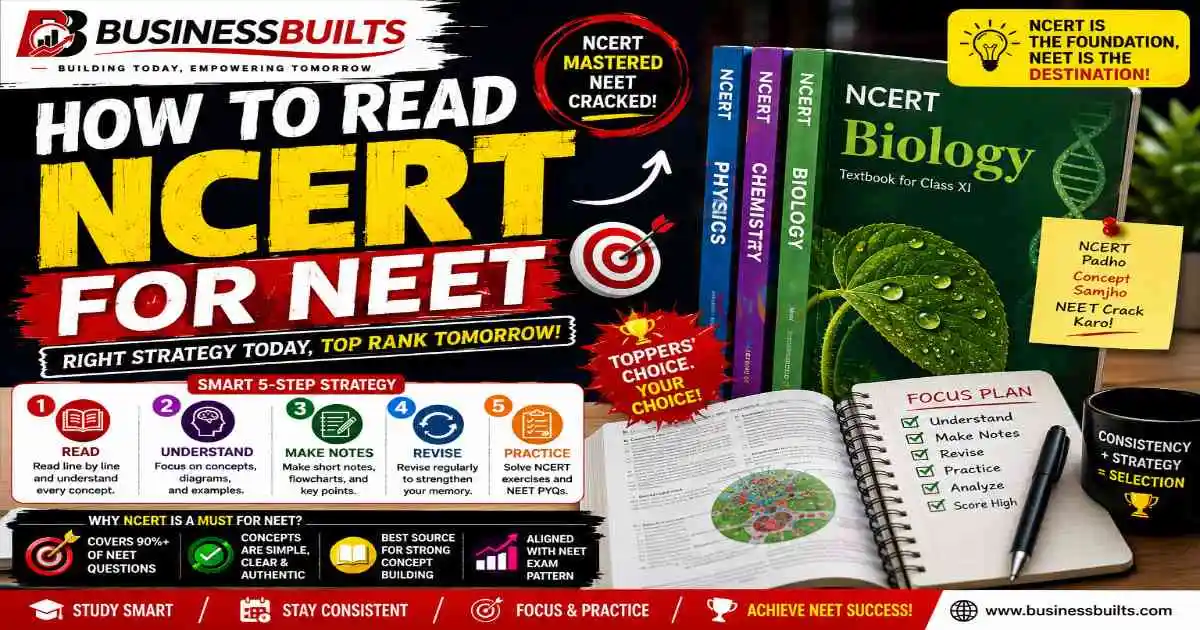
This is the core system in this guide, and it’s the most direct answer to how to read NCERT. Read every chapter three times, each with a different purpose.
First Read: Just for Understanding
Read the chapter start to finish in one sitting. No highlighting, no notes. Just try to understand what the chapter is saying. If you’re reading the Photosynthesis chapter, visualize the process instead of trying to memorize anything at this stage.
Second Read: Line by Line
Now slow down. Go through every line, every diagram, every table, and importantly, every footnote. NEET frequently pulls questions from exactly the footnotes students tend to skip. This is where you highlight, but only the essentials: definitions, exceptions, numbers, and unusual facts. Highlighting entire paragraphs is a common mistake because nothing stands out later during revision.
Third Read: Think Like an Examiner
This time, read NCERT the way a question-paper setter would. After every topic, frame 5 to 10 questions yourself. For example, after finishing the Human Reproduction chapter, ask yourself, “If I were setting this paper, what would I ask from this diagram’s labels?” This single habit is what separates toppers from average scorers.
Subject-Wise Strategy
How to Read NCERT Biology for NEET
Since Biology carries 360 marks, half of NEET’s total score, it deserves a strategy of its own. When people specifically ask how to read NCERT Biology for NEET, the answer starts with diagram labeling, since this is where the most marks are won or lost. Diagrams like the human heart, nephron, the Plasmodium life cycle, and flower structure should be practiced by drawing them from memory, without looking at the book.
Classification tables, such as Kingdom Plantae or Animal Phyla, are best revised in chart form. Pay close attention to scientific spelling too, since an incorrect spelling can mean the option doesn’t match what NEET is asking for.
Assertion-reason questions are common in Biology, so read statements carefully rather than jumping to conclusions based on keywords alone.
Chemistry
For Inorganic Chemistry, memorize NCERT line by line, especially periodic trends and exceptions. For Organic Chemistry, focus on understanding reaction mechanisms rather than just memorizing the reaction itself, and note the conditions for each named reaction, including temperature and catalyst.
In Physical Chemistry, formulas alone won’t help if you haven’t understood the derivation. Try solving NCERT’s solved examples yourself before checking the answer.
Physics
NCERT builds the concept clarity in Physics, but you’ll need additional material for numerical practice. Start with NCERT for the theory, then move to HC Verma or your coaching material for numericals. Never skip NCERT’s back-of-chapter exercises, since direct questions are often pulled from there too.
Class 11 vs Class 12 vs Droppers: Different Students Need Different Approaches

Every student’s situation is different, so a single strategy doesn’t work for everyone.
Class 11 students have the most time on their side. Focus on building a strong foundation, start early, and prioritize Biology and Chemistry since their syllabus is larger. For Physics, spend time on concept clarity first, speed will come later.
Class 12 students need to balance boards with NEET prep. A revision-heavy approach works best here, meaning whatever you covered thoroughly in Class 11 should be revised regularly alongside new Class 12 topics rather than left for later.
Droppers and repeaters shouldn’t reread the entire NCERT from scratch. Instead, identify weak chapters through mock test analysis and revise those specifically. Reading everything again at the same pace as a first-time student wastes the biggest advantage a dropper has: an extra year of familiarity.
First-time candidates should build a realistic timeline rather than trying to do everything at once. Overwhelm is what causes most students to abandon a study plan within the first few weeks.
Balancing NCERT with Coaching Notes
If you’re enrolled in a coaching institute, NCERT and coaching material aren’t competing with each other, they complement each other. Coaching notes are useful for structured problem-solving and shortcuts, but NCERT remains the final authority for concept clarity and exact terminology, especially in Biology and Chemistry, where NEET often uses NCERT’s own wording in its questions.
When in doubt about a concept, go back to NCERT rather than relying only on coaching shortcuts.
Tips for Hindi Medium Students
This is something most guides skip entirely, and it matters for a large number of NEET aspirants across India. Hindi medium NCERT books are available, but since the NEET paper itself is offered in English plus regional languages, it helps to build familiarity with English scientific terms alongside your Hindi medium study.
A simple way to do this is to maintain a bilingual glossary, noting each scientific term in both Hindi and English as you come across it. This avoids confusion during the exam when a question is phrased in English terminology you haven’t seen before.
How Often Should You Revise NCERT
A rough subject-wise target for the number of times you should go through NCERT before NEET:
| Subject | Ideal Read Count |
| Biology | 4-6 times |
| Chemistry | 3-4 times |
| Physics | 2-3 times |
Use a spaced repetition approach for retention, revising a chapter after 1 day, then 3 days, then 7 days, then 15 days. In the final 30 days before the exam, shift entirely to your short notes and highlighted portions rather than rereading full chapters, since your goal at that stage is quick recall, not fresh learning.
Common Mistakes Students Make with NCERT

| Mistake | Why It Hurts | What to Do Instead |
| Reading only once | Not enough for retention | Read at least 3 times with different goals |
| Skipping diagrams | Direct questions come from labels | Practice drawing them from memory |
| Ignoring footnotes | Hidden but important information | Read every line, including footnotes |
| Over-highlighting | Nothing stands out during revision | Highlight only key facts and exceptions |
| Using too many reference books | Leads to confusion and half-finished prep | Stick to NCERT plus one trusted reference |
For Parents: How to Support Your Child’s NCERT Preparation
If you’re a parent trying to help your child through NEET prep, your role isn’t about pushing harder, it’s about creating the right conditions. A quiet, consistent study space matters more than most parents realize.
Track progress gently, perhaps through weekly conversations about which chapters were covered, rather than constant questioning that adds pressure. And know when to bring in additional support: if your child is consistently struggling with a subject despite effort, a coaching institute or a subject-specific mentor can help far more than repeated reminders at home.
Frequently Asked Questions
How can I effectively study NCERT books for NEET preparation?
The most effective way is the three-read method: read once for concept understanding, once line by line for details like diagrams and footnotes, and once as active revision where you frame your own questions. Pair this with regular self-testing and spaced revision rather than passive re-reading.
How to effectively read NCERT textbooks for NEET preparation?
Focus on technique over speed. Highlight only key facts and exceptions instead of entire paragraphs, practice drawing diagrams from memory, and never skip footnotes or back-of-chapter exercises, since NEET frequently picks questions from exactly those overlooked sections.
What are the best digital platforms for NCERT-based NEET study material?
The official NCERT website (ncert.nic.in) offers free, authentic PDFs of every chapter, which should be your primary digital source. Beyond that, look for NCERT-based MCQ apps and the official NTA NEET website for exam pattern updates, and verify any third-party material against the original NCERT text before relying on it.
What is the best way to study NCERT Biology for NEET?
Since Biology contributes 80 to 90% of questions from NCERT, prioritize diagram labeling, classification tables, and exact scientific terminology. Practice drawing key diagrams like the human heart or nephron from memory, and revise assertion-reason style statements carefully rather than skimming for keywords.
How to approach NCERT Chemistry for NEET exam success?
Split your approach by section: memorize Inorganic Chemistry close to word for word, focus on understanding reaction mechanisms in Organic Chemistry rather than rote learning, and solve Physical Chemistry’s worked examples yourself before checking the answer to build genuine numerical confidence.
Tips for mastering NCERT Physics concepts for NEET?
Use NCERT to build conceptual clarity first, then move to a reference book like HC Verma or DC Pandey for numerical practice, since NCERT alone doesn’t provide enough problem variety for Physics. Always complete the back-of-chapter exercises, as direct questions are often drawn from them.
How do online courses structure NCERT reading for NEET success?
Most structured online courses map their video lectures chapter by chapter to NCERT, followed by topic-wise tests, doubt-clearing sessions, and previous year question analysis. The NCERT chapter itself remains the base text, while the course adds practice volume and structured revision on top of it.
How much time should I dedicate to NCERT daily for NEET?
During the early preparation phase, 2 to 3 hours of focused NCERT reading daily, split across subjects based on weightage, is a reasonable target. Closer to the exam, this shifts toward revision of notes and highlighted portions rather than fresh reading time.
NCERT NEET ke liye kaafi hai kya?
Haan, NCERT NEET ka base hai aur zyada tar questions especially Biology me yahin se aate hain. Lekin Physics aur Chemistry ke numericals ke liye NCERT ke saath regular MCQ practice aur previous year questions bhi zaroori hain.
NCERT kitni baar padhni chahiye NEET ke liye?
Biology ko 4 se 6 baar, Chemistry ko 3 se 4 baar, aur Physics ko 2 se 3 baar padhna ideal hai, saath me regular revision cycle bhi follow karna chahiye.
Kya coaching notes NCERT se zyada important hain?
Nahi, coaching notes problem-solving aur structure me help karte hain, lekin concept clarity aur exact terminology ke liye NCERT hi final source hai, kyunki NEET aksar NCERT ki language me hi questions banata hai.
Droppers ko NCERT dobara puri padhni chahiye kya?
Zaroori nahi. Droppers ko apne mock test results dekhke weak chapters identify karne chahiye aur sirf unhi pe focus karna chahiye, poori NCERT dobara se padhna time waste kar sakta hai.
Beginners NCERT kaise padhna shuru karein NEET ke liye?
Beginners ko 3-reading method follow karna chahiye — pehli baar concept samajhna, dusri baar line by line detail, aur teesri baar examiner ki tarah revision karna. Sab kuch ek hi baar me yaad karne ki koshish mat karo.
Kya Hindi medium se NEET crack ho sakta hai?
Bilkul. Hindi medium NCERT books completely valid hain NEET ke liye. Bas saath me ek English terminology glossary banate raho taki exam ke time koi confusion na ho.
Class 11 me NCERT se shuru karein ya coaching notes se?
Class 11 students ko foundation strong karne pe focus karna chahiye, isliye NCERT ko early start karo. Coaching notes ko NCERT ke saath complement ki tarah use karo, replacement ki tarah nahi.
Last 1 mahine me NCERT kaise revise karein?
Last 30 din me poori NCERT dobara padhne ke bajaye apne short notes aur highlighted portions pe focus karo. Is stage me goal fresh learning nahi, fast recall hona chahiye.
NCERT Exemplar NEET ke liye zaroori hai kya?
Haan, khaaskar Chemistry aur Physics ke liye NCERT Exemplar bahut helpful hai. Ye NCERT ke concepts ko thoda tricky level pe test karta hai, jo NEET ke actual difficulty level ke kareeb hota hai.
Class 12 me boards aur NEET dono ke liye NCERT kaise balance karein?
Achi baat ye hai ki boards aur NEET dono ka syllabus same NCERT pe based hai. Isliye ek hi reading se dono prepare ho jaate hain, bas depth thodi zyada rakhni padti hai NEET ke liye.
NCERT padhte time notes kaise banayein?
Poora paragraph copy karne ke bajaye har chapter ka ek-page summary banao jisme sirf important keywords, formulas, aur diagrams ke labels ho. Ye revision ke time bahut time bachata hai.
Parents apne bachche ki NCERT preparation kaise support kar sakte hain?
Ek quiet study environment banao, progress ko weekly casually track karo bina pressure diye, aur agar koi subject me consistently struggle dikhe toh coaching ya mentor ki help lene me deri mat karo.
NCERT ke alawa aur konsi books NEET ke liye zaroori hain?
NCERT base hai, lekin Physics ke liye HC Verma ya DC Pandey, aur teeno subjects ke liye NCERT-based MCQ books jaise MTG ki “NCERT at Your Fingertips” practice ke liye useful hoti hain.
Conclusion
Cracking NEET was never about how many books you own, it’s about how thoroughly you’ve mastered one. Whether you’re just starting in Class 11, balancing boards in Class 12, or working through a dropper year, the same principle applies: read NCERT with intent, not just as a routine. Follow the three-read method, revise on schedule, and treat every diagram and footnote as a potential question rather than filler content.
Ready to Build Your NEET Study Plan?
If this guide helped clear your doubts on how to read NCERT for NEET, don’t stop at reading, put it into action from today. Pick one chapter, apply the 3-reading method, and track how much more you retain by the third pass.
Let us know in the comments which stage of NCERT reading you’re currently at, first read, second read, or revision phase. We’d be happy to help with specific doubts, and if enough of you ask, BusinessBuilts will put together a full 6-month NEET NCERT study calendar next.
About the Author
Ashish Kumar is the Founder of BusinessBuilts, where he writes on business, finance, and now education-focused guides that help Indian students and families make informed decisions. Read more articles by Ashish Kumar at businessbuilts.com/author/ashish-kumar/.
Disclaimer
This article is for general informational and guidance purposes only. NEET exam patterns, syllabus, and eligibility criteria are subject to change as per official NTA and NCERT notifications. Readers are advised to cross-check the latest updates directly from the official NCERT website (ncert.nic.in) and the official NEET website (neet.nta.nic.in) before making any preparation decisions. BusinessBuilts does not guarantee exam outcomes and is not affiliated with NTA or NCERT.
