



Quick Answer
A salary saving scheme is a system that automatically sets aside a fixed portion of your salary, typically 10 to 20 percent, into a savings or investment account before you ever get a chance to spend it. In the US, this usually means a 401(k) or a payroll savings plan tied directly to your paycheck. In India, it usually means EPF, PPF, or an ELSS SIP. The core idea stays the same everywhere: save first, spend what remains.
Last updated: August 2026 | Written by Ashish Kumar, Founder at BusinessBuilts
Most people do not have a spending problem. They have a timing problem. The money that was supposed to go into savings gets spent first, and by the time payday rolls around again, there is nothing left to set aside. A salary saving scheme flips this order. It saves first and lets you spend what remains.
This guide walks through exactly what is a salary saving scheme, how it works, and the best options available whether you are working in the United States or in India. By the end, you will know which scheme fits your income, your goals, and your stage of life. This guide is brought to you by BusinessBuilts, where we break down financial and workplace concepts in plain language.
What Is a Salary Saving Scheme?
A salary saving scheme is any arrangement where a fixed portion of your salary is automatically diverted into savings or investments, either by your employer through payroll or by your bank through an automatic transfer. In the US, this concept is also commonly called a payroll savings plan. The key word here is automatic. You set it up once, and it keeps running in the background every payday without needing your attention.
Think of it like a gym membership that charges you automatically each month. You do not have to remember to pay it, and because the payment already happened, you tend to make use of it. Salary saving works the same way. Once the money leaves your account before you see it, you naturally adjust your spending around what is left, rather than trying to find money to save after you have already spent.
This is different from the common approach most people take, which is to spend through the month and save whatever happens to be left over. That approach depends entirely on discipline holding up every single month, and for most people, it does not.
A salary saving scheme removes that dependency. Whether it is an employer retirement plan, a recurring deposit, or a simple automatic transfer to a separate savings account, the underlying idea is the same: save before you spend, not after. In short, the payroll savings plan definition comes down to one sentence: money is set aside automatically before you can spend it.
How a Salary Saving Scheme Works
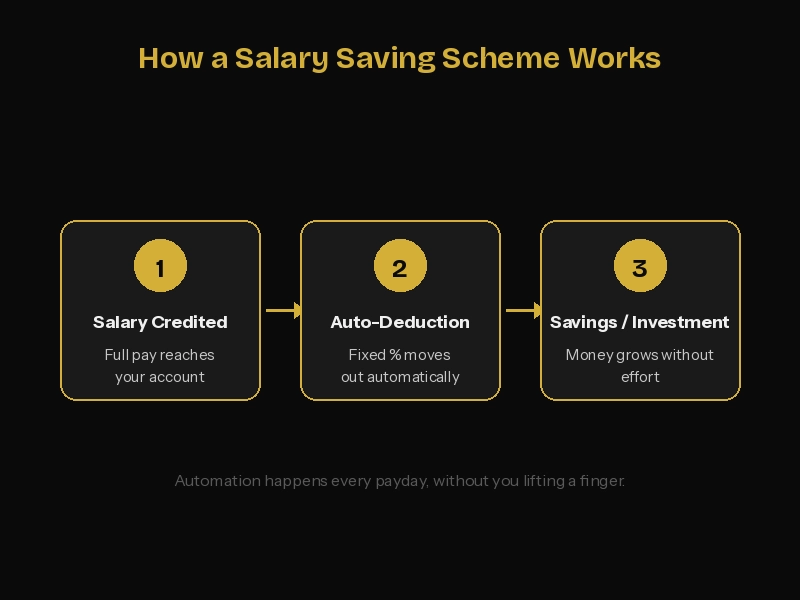
The mechanism behind most salary saving schemes follows a similar pattern, even though the specific products differ between countries.
Step 1: Money enters your account or is deducted before it does. In some schemes, like a 401(k) in the US or EPF in India, the amount never actually touches your bank account. It goes directly from your gross salary into the savings or retirement vehicle. In other schemes, the full salary is credited first, and then an automatic transfer moves a portion out shortly after.
Step 2: The transfer or deduction happens on a fixed schedule. This is usually tied to your payday, so it happens every single pay cycle without you needing to initiate it.
Step 3: The money lands in a savings account, investment fund, or retirement account. Depending on the scheme, this could be a plain savings account earning interest, a mutual fund through a systematic investment plan, or a tax-advantaged retirement account.
Step 4: You review and adjust periodically. A good salary saving scheme is not something you set up once and forget forever. Most people revisit it once or twice a year, especially after a raise, to increase the amount being saved.
Two paths generally exist here. Employer-sponsored schemes are set up through HR or payroll, and self-directed schemes are set up by you directly with your bank or investment platform. Both work well, and many people end up using a combination of both.
Salary Saving Scheme Options in the US
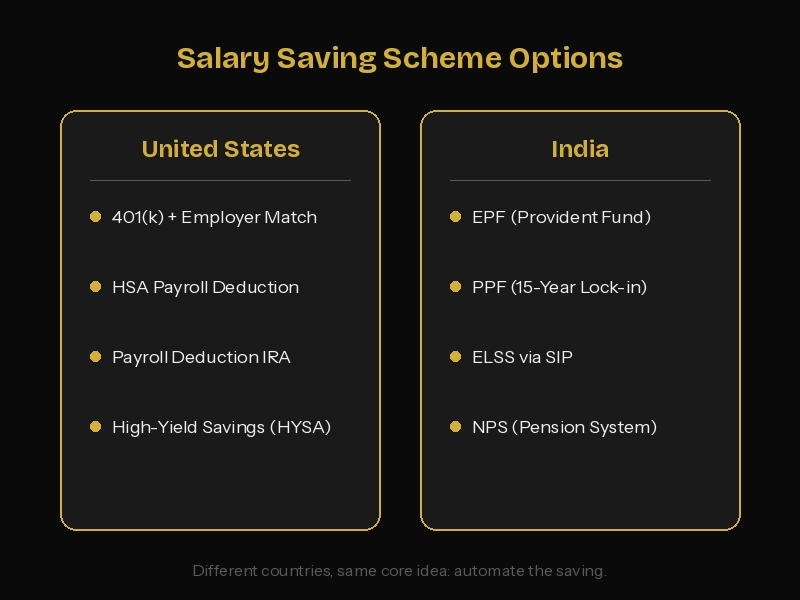
If you are working in the United States, there are several well-established payroll savings plan options worth knowing about. Each serves a slightly different purpose.
401(k) with employer match A 401(k) is the most common employer-sponsored retirement savings plan in the US. A portion of your salary goes into the account before tax, which lowers your taxable income for the year. The part that makes this option stand out is the employer match. Many companies match a percentage of what you contribute, essentially adding free money to your retirement savings. If your employer matches your contribution up to a certain percentage and you are not contributing enough to get the full match, you are leaving money on the table that was meant for you.
Health Savings Account (HSA) payroll deduction If you are enrolled in a high-deductible health plan, an HSA lets you set aside money through payroll deduction for medical expenses. The contributions are tax-advantaged, and unlike some other accounts, unused HSA funds roll over year after year instead of disappearing.
Payroll deduction IRA Some employers who do not offer a 401(k) still allow employees to set up automatic payroll deductions into a traditional or Roth IRA. This gives you the same automation benefit even if your workplace does not have a full retirement plan.
High-yield savings account (HYSA) with automatic transfer Not every saving goal is for retirement. For shorter-term goals like an emergency fund or a vacation, a high-yield savings account with an automatic weekly or monthly transfer works well. These accounts typically offer a noticeably better interest rate than a standard checking or savings account.
Why FDIC insurance matters Whichever bank account you choose for your salary savings, make sure it is FDIC insured. This means your deposits are protected up to the insured limit even if the bank fails, which gives you a real safety net rather than just a promise. You can confirm coverage directly on the FDIC’s official website.
Each of these suits a different kind of earner. A first-time earner in their twenties might prioritize the 401(k) match and a small HYSA for emergencies. A working professional with a family might lean more heavily into the HSA and a payroll deduction IRA for extra retirement cushioning. For the exact, most current contribution limits, the IRS 401(k) contribution limits page is the most reliable source, since these figures are adjusted annually.
Salary Saving Scheme Options in India
In India, salary saving schemes are shaped by a mix of mandatory employer contributions and voluntary tax-saving investments.
Employee Provident Fund (EPF) For most salaried employees working in registered companies, EPF is not optional. A fixed percentage of your basic salary is deducted every month and deposited into your EPF account, with your employer contributing an equal amount. This builds up as a long-term retirement corpus and earns a government-declared interest rate each year. You can check your EPF details directly on the EPFO official portal.
Public Provident Fund (PPF) PPF is a voluntary, government-backed savings scheme with a 15-year lock-in. It is popular because the interest earned and the maturity amount are both tax-free, and contributions qualify for a deduction under Section 80C.
Equity Linked Savings Scheme (ELSS) through SIP For employees who want to combine saving with market-linked growth, an ELSS mutual fund through a Systematic Investment Plan (SIP) lets a fixed amount get auto-debited from your bank account every month. It carries the shortest lock-in among Section 80C options, at three years, and offers the potential for higher returns compared to fixed-return schemes. Before starting one, it helps to use a SIP calculator to estimate how your monthly contribution could grow over time, and you can look at an example like the SBI Contra Fund to understand how a real fund’s returns are tracked.
National Pension System (NPS) NPS is a voluntary retirement savings scheme that lets you choose your own mix of equity and debt exposure. Contributions here offer an additional tax deduction over and above the regular Section 80C limit, making it a popular add-on for employees who have already used up their 80C benefit elsewhere.
Salary account auto-sweep and RD facility Many banks let salary account holders set up an automatic sweep-in facility, where any balance above a set threshold automatically moves into a fixed deposit or recurring deposit. This is a simple way to earn better interest on money that would otherwise sit idle in a regular savings account.
Government employees usually already have a structured pension contribution through their service rules, while private-sector employees have more flexibility in choosing between PPF, ELSS, and NPS based on their goals and risk appetite.
How Much Salary Should You Save?
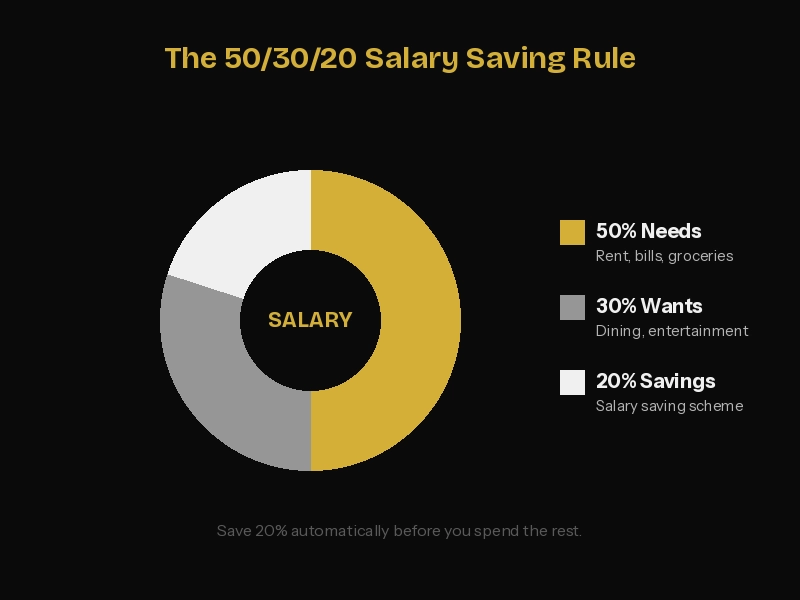
There is no single percentage that works for everyone, but the 50/30/20 rule is a useful starting point for any salary saving scheme. Under this rule, 50 percent of your take-home salary goes toward needs, 30 percent toward wants, and 20 percent toward savings and investments.
Here is what that looks like with real numbers.
| Monthly Take-Home Salary | Suggested Savings (20%) |
| $3,000 (US) | $600 |
| $5,000 (US) | $1,000 |
| ₹40,000 (India) | ₹8,000 |
| ₹80,000 (India) | ₹16,000 |
This is a starting point, not a rule carved in stone. If you are a first-time earner still paying off a student loan or building an emergency fund, you might start closer to 10 percent and increase it gradually. If you are debt-free and have a specific goal like buying a home in five years, you might push well past 20 percent. You can run your own numbers using our financial calculator to see what different saving percentages look like for your exact salary.
The number that matters most is not a fixed percentage. It is whether the amount is automated and consistent, month after month, regardless of how motivated you feel that particular week.
Common Mistakes to Avoid With Salary Saving Schemes
Most articles on this topic stop at listing the benefits. Here is what actually trips people up in practice.
Waiting for the “right time” to start There is rarely a perfect moment to begin saving. Waiting for a raise, a promotion, or a less busy month usually just delays the habit by months or years. Starting small immediately beats waiting for an ideal amount later.
Not claiming the full employer match This applies specifically to US employees with a 401(k). If your employer matches contributions up to 4 percent and you are only contributing 2 percent, you are giving up guaranteed money that was part of your compensation package.
Locking everything into long-term schemes with no emergency fund Putting your entire savings into PPF or a 401(k) with no accessible emergency fund is a common mistake. If an unexpected expense comes up, you may be forced to take a loan or an early withdrawal, often with penalties, when a simple liquid emergency fund would have avoided that entirely.
Never increasing the saved amount as salary grows It is easy to set up a saving scheme once and forget to revisit it. If your salary has increased over the past two years but your saved amount has stayed the same, you are effectively saving a smaller percentage of your income than before.
Choosing a scheme without checking withdrawal flexibility Some schemes come with long lock-ins or penalties for early withdrawal. Before committing a large amount, it helps to know exactly when and how you can access that money if you genuinely need it.
How to Set Up a Salary Saving Scheme
Setting one up is simpler than most people expect. Here is a practical sequence to follow.
- Review your take-home salary and fixed monthly expenses. Know what is genuinely left over before deciding how much to save.
- Decide between an employer-linked scheme and a self-directed one. If your employer offers a 401(k) match or EPF, that is usually the first place to start since it comes with either free matching money or mandatory contribution benefits.
- Talk to your HR or payroll team. Ask what employer-sponsored options exist and how to enroll. This conversation alone often reveals benefits many employees never knew were available to them.
- Set up an automatic transfer with your bank for anything self-directed. Whether it is a recurring deposit, a SIP, or a transfer to a high-yield savings account, automation is what makes the scheme actually work.
- Review the amount once or twice a year, especially after a salary increase, and adjust it upward when you can.
Frequently Asked Questions
Is a salary saving scheme mandatory?
It depends on the type. Employer-linked schemes like EPF in India are usually mandatory for eligible employees. Others, like a 401(k), PPF, or a high-yield savings account, are voluntary and set up by choice.
Can I change my salary saving scheme contribution later?
Yes, in most cases. You can typically increase, decrease, or pause contributions to voluntary schemes like a 401(k), SIP, or automatic bank transfer. Mandatory schemes like EPF usually follow a fixed percentage set by regulation.
What is the difference between a salary account and a salary saving scheme?
A salary account is simply the bank account where your salary gets credited each month. A salary saving scheme is what happens after that, the automatic process of moving a portion of that salary into savings or investments.
Is a 401(k) the same as a salary saving scheme?
A 401(k) is one specific type of payroll savings plan, used in the US and focused on retirement. The broader term covers any automated saving method tied to your salary, including HYSAs, SIPs, and EPF.
How much of my salary should go into savings each month?
A common starting point is 20 percent of take-home pay, following the 50/30/20 rule. The right number for you depends on your expenses, debt, and goals, and it is fine to start lower and increase it over time.
Are salary saving schemes safe?
Bank-based schemes like FDIC-insured HYSAs in the US or PPF and EPF in India are considered safe, backed either by deposit insurance or government guarantees. Market-linked options like a 401(k) or ELSS carry investment risk, since returns depend on market performance, though they also offer higher growth potential over the long term.
Salary saving scheme kya hota hai?
Salary saving scheme ek aisa system hai jisme aapki salary ka ek fixed hissa automatically save ya invest ho jata hai, isse pehle ki aap use kharch kar payein. Jaise EPF, PPF, ya ek automatic bank transfer.
Kya salary saving scheme har employee ke liye zaroori hai?
EPF jaisi kuch schemes private-sector employees ke liye mandatory hoti hain, lekin PPF, NPS, ya ELSS SIP jaisi schemes voluntary hoti hain, matlab aap khud decide kar sakte hain ki inhe start karna hai ya nahi.
Salary saving scheme mein kitna paisa save karna chahiye?
Ek common starting point hai apni take-home salary ka 20 percent, jise 50/30/20 rule follow karke calculate kiya ja sakta hai. Beginners chahe toh 10 percent se bhi start kar sakte hain aur dheere-dheere badha sakte hain.
Related Posts
Final Thoughts
A salary saving scheme works because it removes the one variable that trips up most saving plans: relying on yourself to remember and follow through every single month. Whether you choose a 401(k) match in the US, an EPF and PPF combination in India, or a simple automatic transfer to a high-yield savings account, the mechanism that matters most is automation.
Start with whatever percentage feels realistic today, set it up once, and let it run in the background. Small, consistent, automatic saving beats an ambitious plan that only works when you remember to follow it. The habit matters more than the exact number you start with.
Ready to Start Saving Automatically?
Not sure which salary saving scheme fits your situation? Explore more BusinessBuilts personal finance guides, or try our SIP calculator and all-in-one financial calculator to see exactly how your monthly savings could grow over time.
About the Author
Written by Ashish Kumar, Founder at BusinessBuilts
Ashish Kumar is a finance and business content writer with over 5 years of experience specializing in personal finance, banking, insurance, taxation, investments, fintech, and business trends. Through BusinessBuilts, he publishes well-researched, accurate, and easy-to-understand content based on credible sources and the latest industry developments to help readers make informed financial decisions.
Disclaimer: This article is for general informational purposes only and does not constitute financial advice. Contribution limits, tax rules, and interest rates mentioned here are subject to change and may vary by employer, bank, or jurisdiction. Readers should verify current figures on official sources such as the IRS or EPFO, and consult a qualified financial advisor before making any investment or savings decision.

1 Comment
Pingback: Family Floater Vs Individual Health Insurance: Best Pick