


Last updated: July 2026 | Written by Ashish Kumar, Founder at BusinessBuilts
You open Chrome. There’s a bar at the top that says “Search Google or type a URL.” You’ve probably typed something into it a hundred times without really thinking about it. But if you’ve ever paused and wondered what that phrase actually means, you’re not alone. Search Google or type a URL is one of the most-seen lines on the internet, and almost nobody explains it in plain language.
You might have even come across a search google or type a url meme online, usually joking about someone forgetting to add “.com” and ending up with search results instead of the website they wanted. It’s funny because it’s true, and it’s exactly the kind of mix-up this guide will help you avoid.
At BusinessBuilts, we get questions like this a lot from students and new internet users. So let’s break it down properly, no tech jargon, just a clear explanation you’ll actually remember.
What Does “Search Google or Type a URL” Mean?

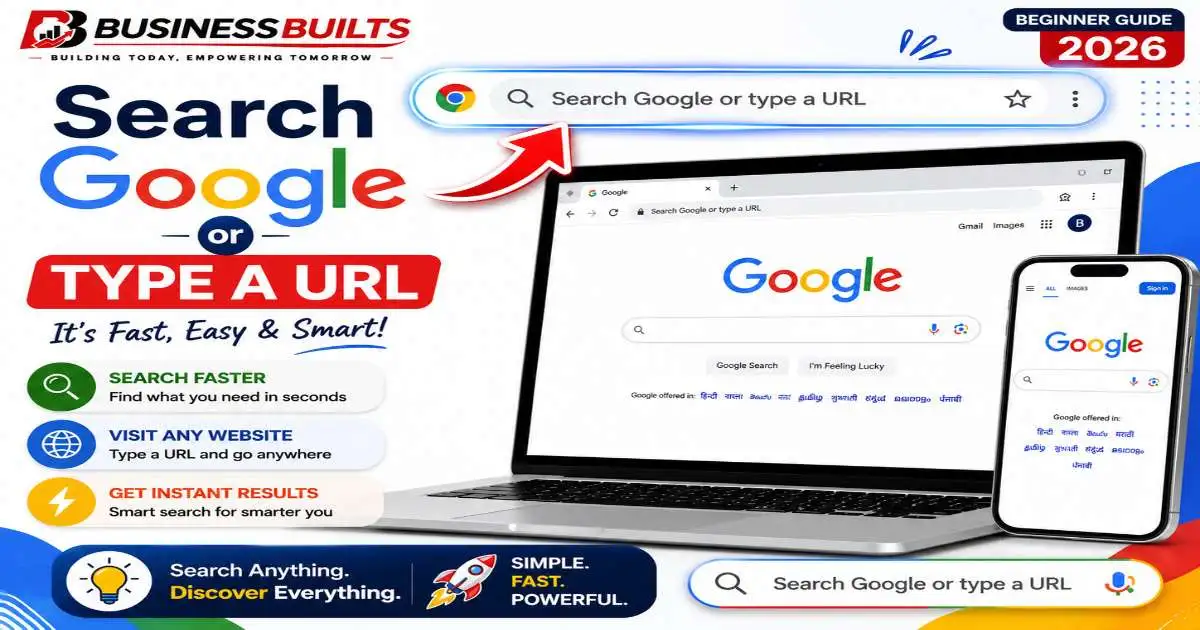
If you’ve been searching for the search google or type a url meaning, here’s the simplest explanation. That one bar at the top of your browser lets you do two different things.
You can either type a few words to search for something, like “how to make maggi” or “best colleges near me.” Or you can type the exact address of a website, like “youtube.com,” and go straight there.
That’s it. It’s not a question, not a command, and definitely not an error message. It’s just your browser telling you, “hey, I can search the web for you, or take you directly to a site, your choice.”
Here’s the simplest way to picture it: type “youtube” and Chrome will search Google for that word. Type “youtube.com” and Chrome takes you straight to YouTube’s homepage. The dot and the “.com” make all the difference.
Where Do You See This Message? (Chrome, Mobile and PC)
If you open a new tab on Chrome desktop, you’ll see this phrase sitting right in the middle of the search box, and again at the top in the address bar. Both do the same job. The search google or type a url chrome prompt shows up in these two spots specifically because Chrome is Google’s own browser, so it defaults to Google search unless you change it.
On mobile, it looks a little different. Open Chrome on your Android or iPhone and you’ll see a search bar on the home screen along with the address bar when you open a new tab. The wording is the same, but the box is smaller and sits closer to your thumb for easy typing.
And it’s not just Chrome. Every major browser has its own version of this. Safari says “Search or enter website name.” Firefox says “Search or enter address.” Microsoft Edge says “Search or enter web address.” They all mean exactly the same thing, Google just happens to be Chrome’s default search engine, so Chrome names it directly.
If you’ve been confused about why your Chrome homepage keeps showing this line, now you know. It’s not a glitch. It’s the whole point of the browser.
What Is the Address Bar (Also Called the Omnibox)?
That bar at the top has a name most people never hear: the omnibox. Google gave it this name back in 2008 when Chrome first launched. Before that, browsers had two separate boxes, one just for typing website addresses, and a completely different one for searching.
Someone at Google realized that was one box too many. Why should you have to think about which box to use before you even start typing? So they combined both into a single smart bar, and every other browser followed the same idea soon after. You can read more about how the default search engine and omnibox settings work directly from Google’s own support page.
The omnibox does more than you’d expect. Beyond search and website visits, it can:
- Solve quick math, type “25 x 4” and get the answer instantly
- Convert units, type “10 km to miles”
- Show your browsing history and bookmarks as you type
- Suggest websites based on what you’ve visited before
It’s basically doing three or four jobs while looking like a plain text box.
Search Google vs Type a URL: Step-by-Step Difference

Let’s compare both actions side by side, since this is where most beginners get mixed up.
| Search Google | Type a URL | |
| What you type | Words or a question | A specific website address |
| Example | “weather in Delhi today” | “accuweather.com” |
| What happens | Chrome shows a list of search results | Chrome opens that exact website |
| Best for | Finding information, exploring options | Going somewhere you already know |
Searching Google, step by step:
- Type your question or keywords into the bar
- Press Enter
- Chrome shows you a page full of results
- You click the one that looks most relevant
Typing a URL, step by step:
- Type the exact web address (like “wikipedia.org”)
- Press Enter
- Chrome skips the search results entirely and opens that site directly
If you’re a student writing an assignment and you’re not sure which website has the answer, searching is your friend. But if you already know you need to log into your college portal, typing the exact URL gets you there faster, with no detours.
How Does the Browser Know What You Mean?
This is the part that actually surprises most people. Your browser isn’t guessing randomly, it’s reading clues in what you type.

If what you type has spaces in it, or reads like a sentence or question, Chrome treats it as a search. If what you type has a dot followed by something like “.com,” “.org,” or “.in,” and no spaces, Chrome treats it as a website address and tries to open it directly.
That’s exactly why typing “facebook” often opens a Google search instead of Facebook itself. The word “facebook” alone is ambiguous, it could be the website, or it could be someone researching news about the company. But type “facebook.com,” and there’s no ambiguity left. Chrome knows exactly where you want to go.
Try it yourself right now. Open a new tab, type “amazon,” and watch what happens. Then try “amazon.in.” You’ll see the difference immediately.
When Should You Search vs When Should You Type a URL?
Use search when:
- You don’t know the exact website you need
- You’re learning something new, like “how photosynthesis works”
- You want to compare a few options, like “best laptops under 40000”
- You’re not sure how a name is spelled or which extension a site uses (.com vs .in vs .co)
Type the URL directly when:
- You already know the exact address, like “gmail.com” or “wikipedia.org”
- You’re logging into something important, like online banking or your school portal
- You want to avoid clicking on ads or copycat websites that sometimes show up in search results
- You visit the same site every day and just want to get there fast
A good habit for students: if it’s something sensitive, like your bank’s website or your college’s fee payment page, always type the URL yourself instead of clicking a link from a random search result or message. It only takes a few extra seconds and it keeps you a lot safer.
Safety Tips for Students and Beginners
Since a lot of new internet users are still learning the ropes, here are a few things worth knowing early on.
Check the spelling before you click. Scammers create fake websites with addresses that look almost identical to real ones, like swapping an “l” for a “1.” Always double check the address, especially before entering any personal details.
Look for the padlock icon. If a website’s address starts with “https” and shows a small padlock next to it, that means the connection is encrypted, which is important for anything involving passwords or payment information. If a site shows “Not Secure,” avoid entering personal information there.
Know the difference between ads and organic results. When you search on Google, the top one or two results are sometimes marked “Sponsored” or “Ad.” These are paid listings, not necessarily the most trustworthy option. The results below them are organic, meaning Google ranked them based on relevance and quality, not payment. Chrome also runs Google Safe Browsing in the background, which warns you before you land on a site known for phishing or malware.
Don’t assume incognito mode makes you invisible. A lot of beginners think opening an incognito window hides everything from everyone. It only stops your own device from saving your browsing history locally. Your internet provider, school network, or the websites themselves can still see your activity.
Why Does the Address Bar Sometimes Look Black?
If your address bar looks black instead of white, don’t worry, nothing is broken. A search google or type a url black background usually just means you have Chrome’s dark mode turned on, either through your phone’s system settings or Chrome’s own theme option. The bar still works exactly the same way, only the colours change. You can switch back anytime from Chrome’s settings under “Themes.”
Common Mistakes New Users Make
A few small mix-ups happen again and again with new internet users, so it helps to know them in advance.
Typing a single word and expecting it to open a website directly. As we covered earlier, single words are often treated as searches because they’re ambiguous. Add the “.com” or full domain to be safe.
Confusing the browser’s homepage with a search engine. Chrome itself isn’t a search engine, it’s the app you’re using. Google is the search engine that runs behind the scenes when you type a search query.
Clicking the first autocomplete suggestion without reading it. Chrome suggests things as you type based on your history, but that suggestion isn’t always what you meant to type. Take a second look before hitting Enter.
Assuming every link in search results is safe to click. Even Google can occasionally show scam sites, especially in ad slots. A quick glance at the web address before clicking goes a long way.
Quick Recap: Your Search Google or Type a URL Cheat Sheet
If you remember nothing else from this article, remember this one rule.
Know exactly where you’re going? Type the URL. Not sure, exploring, or asking a question? Search Google.
That’s genuinely the whole decision in one sentence. Everything else is just detail around that core idea.
Frequently Asked Questions
What does “Search Google or type a URL” mean?
It’s the placeholder text in your browser’s address bar. It tells you that you can either type keywords to search Google, or type a specific website address to go there directly.
Is “Search Google or type a URL” a virus or an error?
No, it’s completely normal. Every browser shows some version of this message. It only becomes a concern if your search engine changes on its own or you get redirected to unfamiliar websites without doing anything.
Does this work differently on mobile than on PC?
The idea is exactly the same on both. The only difference is the size and position of the box, mobile screens are smaller, so the search bar sits closer to your thumb.
I typed a URL but Chrome searched instead. Why?
This usually happens when what you typed didn’t clearly look like a web address, maybe you left out the “.com” or made a small typo. Try typing the full address again, including the extension.
Is it safer to search or to type a URL directly?
For everyday browsing, both are fine. But for sensitive things like banking or logging into accounts, typing the URL yourself is safer since it avoids the risk of clicking a fake link disguised as the real thing.
Search google or type a url ka matlab hindi mein kya hai?
Bahut se users search google or type a url in hindi bhi search karte hain. Iska simple matlab hai, aap chahein to Google par kuch search kar sakte hain keywords type karke, ya phir seedha website ka address (URL) type karke us site par ja sakte hain. Dono option same address bar mein kaam karte hain, bas aapko decide karna hai ki aapko kya chahiye, search results ya seedha website.
Chrome ka address bar aur search bar same cheez hai kya?
Haan, bilkul same hai. Pehle browsers mein do alag boxes hote the, ek address ke liye aur ek search ke liye. Ab Chrome dono ko ek hi bar mein combine kar deta hai, jise omnibox kehte hain. Aap usi ek bar mein search bhi kar sakte hain aur website bhi khol sakte hain.
Agar main galti se kuch type kar du to kya hoga?
Kuch nahi hoga, tension mat lijiye. Agar aap koi word ya sentence type karte hain jo website address jaisa nahi lagta, Chrome usse automatically Google search bana dega. Aapko bas Enter dabana hai aur relevant results dekh kar sahi link par click karna hai.
Mobile aur laptop mein ye feature alag kaam karta hai kya?
Nahi, dono mein kaam ek jaisa hi hota hai. Bas mobile mein search bar chhota hota hai aur thumb ke paas hota hai taaki type karna easy ho. Laptop mein bar upar top pe hota hai. Function bilkul same rehta hai.
Naye users ko is address bar ko use karte time kya dhyan rakhna chahiye?
Sabse important baat, spelling sahi type karein, especially banking ya login wali websites ke liye. Agar aapko exact website address pata hai to seedha wahi type karein, guessing mat karein. Aur agar koi cheez samajh nahi aa rahi ho, jaise ek naya symbol ya suggestion, panic mat kijiye, ye zyada tar cases mein normal browser behavior hi hota hai.
Now that you understand what search Google or type a URL really means, that bar at the top of your browser probably feels a lot less mysterious. It’s one of those basics that makes everything else about using the internet click into place, and once you get comfortable with it, browsing feels a lot more like second nature.
Still confused about something in your browser? Drop your question in the comments, or explore more beginner tech guides on BusinessBuilts. We break down the confusing stuff so you don’t have to Google it twice.
About the Author
Written by Ashish Kumar, Founder at BusinessBuilts
The BusinessBuilts Editorial Team writes simple, practical guides on browsers, search, and everyday internet basics for students and first-time users. Every guide is reviewed for accuracy before publishing and updated regularly to reflect changes in Chrome and other browsers. Have feedback or a topic you want covered? Reach out to us through the BusinessBuilts contact page.
Disclaimer: This article is for general informational purposes only. Browser menus, settings, and steps may vary slightly depending on your device and Chrome version. Google, Chrome, YouTube, Gmail, and other brand names mentioned are used only as examples and are trademarks of their respective owners; BusinessBuilts is not affiliated with them.
