


Last updated: July 2026 | Written by Ashish Kumar, Founder at BusinessBuilts
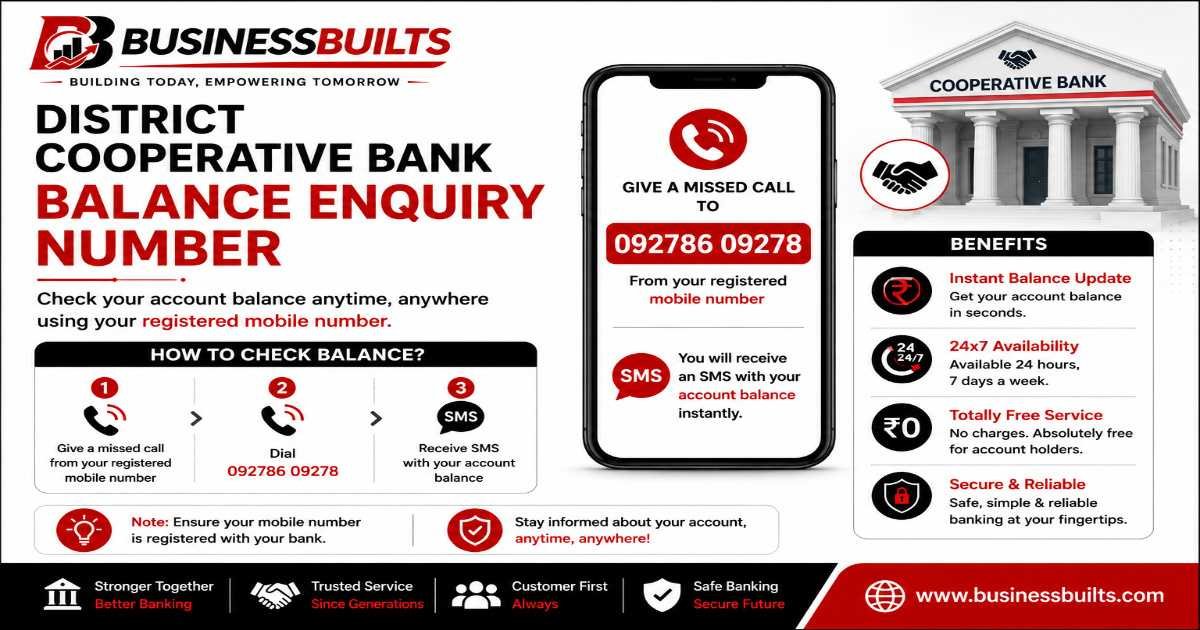
If you searched for “district cooperative bank balance enquiry number,” there’s a good chance you didn’t find what you were looking for. That’s not your fault. It’s because this phrase covers hundreds of different banks, and most of the pages online only talk about one of them, or worse, about a completely different bank that just happens to share a similar name.
Let’s clear that up first, then get you to the actual number you need. This guide from BusinessBuilts is built specifically to sort out that confusion, with numbers verified straight from official bank sources.
There’s No Single “District Cooperative Bank”
This is the part almost nobody explains clearly, so here it is in plain terms.
A District Cooperative Bank, usually called a District Central Cooperative Bank or DCC Bank, is a cooperative bank set up for one specific district. Maharashtra alone has over 30 of them, one for Pune, one for Nashik, one for Sindhudurg, one for Thane, and so on. Gujarat, Tamil Nadu, Rajasthan, Karnataka, and Uttar Pradesh each have their own separate lists too. Every single one is registered on its own, has its own board, and runs its own customer service, including its own balance enquiry number.
So when you type “district cooperative bank balance enquiry number” into Google, you’re really asking a question that only makes sense once you add your district’s name to it. “Nashik district cooperative bank balance enquiry number” has one answer. “Sindhudurg district cooperative bank balance enquiry number” has a different one.
There’s a second layer of confusion that trips up even more people.
District Cooperative Bank Is Not the Same as DCB Bank

Search “DCB bank balance enquiry number” and you’ll land on pages for DCB Bank, a private sector bank headquartered in Mumbai with over 400 branches across India. It has no connection to district cooperative banks at all. The overlap is just the initials.
If you’re a DCB Bank customer, here’s your number directly: give a missed call to 7506660011 from your registered mobile number, and you’ll get an SMS with your balance within a minute or two.
But if your passbook says something like “Ahmedabad District Co-operative Bank” or “Nashik District Central Co-op Bank,” you’re not a DCB Bank customer, and that number won’t work for you. You need your specific district’s number, which we’ll get to next.
One more thing worth knowing regardless of which bank you’re with: deposits at both cooperative banks and DCB Bank are insured up to ₹5 lakh per depositor by DICGC, the RBI’s deposit insurance arm. It’s a good idea to know this exists, especially with smaller cooperative banks.
How to Find Your Exact District Cooperative Bank’s Number

Before jumping into a directory, it helps to know how to verify any DCC bank missed call number yourself, because these banks update their numbers more often than you’d expect, and a list on the internet can go stale.
Check your passbook first. Most DCC banks print their missed call number, SMS banking number, and a landline customer care number right on the first or last page of the passbook. This is the fastest and most reliable source, since it came directly from your own branch.
Look up your IFSC code. Every bank account has an IFSC code, and that code tells you exactly which bank you’re with, down to the branch. For example, Nashik District Central Cooperative Bank’s IFSC code is ICIC00NDCCB. You can find your IFSC code on your chequebook, your passbook, or by searching your bank name on the RBI’s official bank branch locator. If you’re with a Regional Rural Bank instead, like Uttar Bihar Gramin Bank, account numbers follow a different format altogether, see our Uttar Bihar Gramin Bank account number digits explainer if that’s you.
Search “[your bank’s exact name] + missed call banking.” Once you know the precise name from your passbook or IFSC lookup, search that exact name rather than the generic term. “Sindhudurg District Central Co-Operative Bank missed call” will get you straight to the right page instead of a mix of unrelated banks.
Be careful with numbers shared on WhatsApp or forwarded messages. Cooperative banks, especially smaller district ones, are a common target for phishing scams because customers often don’t have an official app to double-check against. If a number was forwarded to you rather than pulled from an official source, verify it against the bank’s own website or your passbook before calling.
District Cooperative Bank Balance Enquiry Numbers (Verified Examples)
Here are numbers pulled directly from official bank sources, along with a couple of real examples that show why “just call the missed call number” doesn’t always apply.
Ahmedabad District Co-operative Bank (ADC Bank), Gujarat Missed call for balance enquiry: 9289224010 The bank sends an SMS with the balance of your first linked savings or current account. If you have more than one account, you’ll need to use their mobile banking app to see all of them, since the missed call service only covers the primary one.
Sindhudurg District Central Co-Operative Bank, Maharashtra Missed call for balance enquiry: 9212443824 This one requires a one-time registration at your home branch before the missed call service activates. It only works for savings accounts, not current accounts, and it only works from the mobile number that’s registered against that specific account.
Nashik District Central Co-operative Bank, Maharashtra No missed call balance service is listed on their official site. Instead, customers reach the bank through its head office numbers: (0253) 2504381 / 83 / 84. This is actually a useful example because it shows that missed call banking isn’t universal across every DCC bank. Some, especially ones serving largely rural and agricultural customer bases, still run primarily through branch visits and landline support.
If your district isn’t listed above, that’s expected. There isn’t a reliable single source that covers all 370-plus DCC banks with current numbers, and any list claiming otherwise should be treated with some skepticism. Use the passbook and IFSC method above, it takes about two minutes and gives you a number you can trust.
Other Ways to Check Your Balance If Missed Call Banking Isn’t Available
Since missed call service varies bank to bank, it helps to know your backup options.
Cooperative bank SMS banking. Many DCC banks support a keyword-based SMS system, similar to texting “BAL” to a specific number. You’ll need to register your mobile number at the branch first, since the bank has to link that number to your account before it recognizes your SMS request. If you actually bank with a different institution, the process looks different: UCO Bank customers can use our UCO Bank missed call balance check number guide, and Allahabad Bank customers (now part of Indian Bank) can check our Allahabad Bank balance check guide.
Passbook update. This is still the most universal method across cooperative banks. Walk into any branch with your passbook, and the teller will print your latest transactions and current balance in a couple of minutes.
Mobile banking apps. A growing number of DCC banks have launched their own apps, ADC Bank is one example. But plenty of smaller district banks, like Nashik DCC in our example above, haven’t rolled one out yet. Check your bank’s official website under “digital banking” or “mobile banking” to see if this applies to you.
Net banking. Coverage here is uneven too. Larger, more urban district banks tend to offer it; smaller ones are often still in the process of building it out.
ATM balance enquiry. If your DCC bank issues its own debit card or has a tie-up with the RuPay network, you can check your balance at any compatible ATM using your card and PIN, no missed call needed.
What to Do If the Missed Call or SMS Doesn’t Work

This happens more often with cooperative banks than with large private or PSU banks, mainly because their IT infrastructure is smaller and sometimes runs on older systems. A few things to check before assuming something’s broken:
Make sure you’re calling from the exact mobile number registered against your account, not just any number you own. Banks like Sindhudurg DCC explicitly tie the missed call service to one specific number per account.
Confirm your number is actually registered. If you opened your account years ago or changed your phone number since, the bank may not have your current number on file. You’ll need to visit the branch with ID proof to update it.
Check that your phone isn’t on airplane mode and that you have signal, especially if you’re in a rural area where coverage from your specific carrier can be patchy near some cooperative bank branches.
If none of that works, call the branch directly using the landline number from your passbook. For a DCC bank, the branch itself is usually faster to resolve this than dialing a general cooperative bank customer care number, since these are smaller, more localized institutions than a big national bank.
District Cooperative Bank vs. DCB Bank at a Glance
| District Cooperative Bank (DCC Bank) | DCB Bank | |
| Ownership | Cooperative, member-owned, one per district | Private, shareholder-owned, national |
| Regulation | RBI plus state cooperative societies act | RBI, as a scheduled commercial bank |
| Typical customers | Farmers, PACS members, local traders, rural households | Broader retail and business banking customers across India |
| Digital banking | Varies widely by district, some have apps, some don’t | Full suite of net banking, mobile app, missed call, SMS |
| Balance enquiry number | Different for every district | Single number nationwide: 7506660011 |
If you landed here looking for DCB Bank specifically, that table should confirm it and send you to the right number above.
Managing Your Finances Beyond Balance Checks
Once your balance is sorted, it’s worth thinking about where that money goes next. If you’re saving a little every month, our SIP Calculator shows how that adds up over time. Got a lump sum instead, maybe from a matured FD or a bonus? Try the Lumpsum Calculator to see its growth potential. Planning to take a loan, our EMI Calculator helps you work out what you’ll actually pay each month before you commit. And if you’re comparing where to park your savings, our FD Calculator makes it easy to check returns across different tenures and banks.
Frequently Asked Questions
Is District Cooperative Bank the same as DCB Bank?
No. DCB Bank is a private, national bank. A District Cooperative Bank is a separate, district-specific cooperative institution. The similar name is a coincidence, not a connection.
Is missed call balance enquiry free?
Yes, at every DCC bank we checked, the missed call service is free. The call disconnects automatically after one or two rings, so you’re not charged for talk time either.
What if my District Cooperative Bank doesn’t offer missed call service?
Use SMS banking if it’s available, or visit your branch to get your passbook updated. Smaller DCC banks, particularly in more rural districts, sometimes rely mainly on branch visits rather than digital channels.
How do I register my mobile number for balance alerts?
Visit your home branch with your passbook and a valid ID. Most DCC banks require this in-person registration step before any missed call or SMS service will work, since they need to confirm the number belongs to you.
Can I check my District Cooperative Bank balance through UPI?
Only if your bank has enabled UPI on your account and you’ve linked it through a UPI app. Not every DCC bank supports this yet, so check with your branch if you’re not sure your account is UPI-enabled.
Where can I find my bank’s exact customer care number?
Your passbook is the quickest source. If you don’t have it handy, look up your account’s IFSC code and search your bank’s exact registered name to find its official website.
Didn’t find your district cooperative bank listed?
Drop your bank’s name in the comments below and we’ll verify the number and add it to this list.
Whichever district cooperative bank balance enquiry number you needed today, bookmark this page, since these numbers get updated more often than you’d expect. And while you’re here, explore our free SIP, EMI, and FD Calculators to plan what comes next after you check your balance.
This guide is maintained by BusinessBuilts and verified against official bank sources. Numbers for cooperative banks can change, so if you spot one that’s outdated, double-check against your passbook or your bank’s official website before relying on it.
About the Author
Ashish Kumar is a digital marketer and the founder of BusinessBuilts, based in Binauli, Baghpat, Uttar Pradesh. What started as a personal effort to make sense of confusing finance and banking topics turned into BusinessBuilts, a site built to give readers straightforward, jargon-free answers on business, personal finance, banking, insurance, taxes, and investing. Every article is written and fact-checked with one goal: to actually answer the question you searched for.
